Written by Samina, Epiclectic Editorial Team · Reviewed by Shahinur Chowdhury, Senior Accountant · Applies to the 2026/27 tax year · Last reviewed November 2026
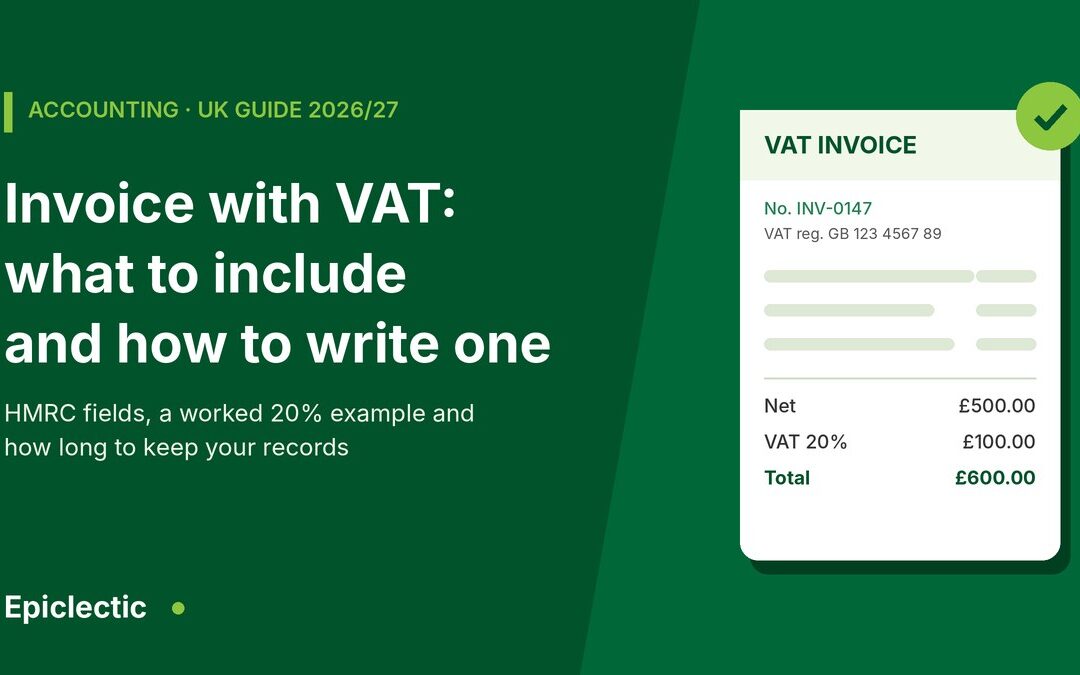
A valid invoice with VAT needs a unique sequential number, your VAT number, the customer’s details, the tax point, the VAT rate on each line and the VAT total in sterling. If one is missing, your customer may be unable to reclaim the VAT. This guide covers the fields, the calculations, the shorter formats and the records to keep.
Quick answer
An invoice with VAT must come from a VAT-registered business. It shows a unique sequential number, your name, address and VAT number, the customer’s name and address, the tax point, a description of each item, the VAT rate and amount, and the total payable. A business that is not a retailer may issue a simplified invoice when the supply is £250 or less including VAT. The invoice is normally due within 30 days of the date of supply.
Why trust this guide
- Sources: GOV.UK’s VAT guide (Notice 700), Record keeping (VAT Notice 700/21), VAT Notice 700/22 on Making Tax Digital for VAT, and HMRC’s Check a UK VAT number service.
- How it was checked: invoice content, the £250 simplified-invoice limit, the 30-day rule and the six-year retention period were checked against HMRC guidance and secondary commentary on 15 November 2026. Figures we could not confirm on a GOV.UK page are flagged in the text.
- Worked examples: every calculation is labelled as illustrative. None is an official figure or a real client.
- Last reviewed: 15 November 2026. Epiclectic is owned by Eternity Accountants Limited.
On this page
- What does an invoice with VAT have to include?
- How do you write an invoice with VAT, step by step?
- How is VAT calculated on an invoice with VAT?
- Can you use a simplified invoice or a receipt instead of a full invoice with VAT?
- Who can issue an invoice with VAT, and when must you send it?
- Trading names, foreign currency, pro forma invoices and credit notes
- What mistakes make an invoice with VAT invalid or costly?
- How long should you keep VAT invoices, and does Making Tax Digital change how you invoice?
- What should you do next if you are not sure your invoices are right?
- FAQs about an invoice with VAT
What does an invoice with VAT have to include?
A full VAT invoice shows a unique sequential number, the tax point, your name, address and VAT number, the customer’s name and address, a description of what you supplied, quantity or extent, unit price, VAT rate, amount excluding VAT, any cash discount rate, the total VAT in sterling and the total payable.
HMRC sets the list in its VAT guide and its record-keeping notice. The guide requires a sequential number based on one or more series that uniquely identifies the document, the time of supply (tax point), the date of issue where it differs, and your name, address and VAT registration number. The remaining items cover the customer, the goods or services and the money.
The table below puts each field in plain English and shows the error it usually prevents. The structure is ours. The underlying requirements come from VAT Notice 700 and VAT Notice 700/21.
| Field | What to enter | Mistake it prevents |
|---|---|---|
| Sequential number | A number from a series that never repeats, such as INV-0147 | Duplicate numbers and gaps you cannot explain |
| Tax point (time of supply) | The date the supply happens, plus the issue date if different | VAT reported in the wrong period |
| Your details | Name, address and VAT registration number | A customer’s claim being refused |
| Customer details | Customer’s name and address | An invoice that cannot be tied to the right buyer |
| Description | Enough detail to identify the goods or services, with quantity or extent | Vague lines such as “services” that invite questions |
| Unit price and net amount | Price per unit and amount excluding VAT, per line | Totals that cannot be reconciled |
| VAT rate per line | 20%, 5% or 0%, shown against each description | Mixed-rate invoices with one blended figure |
| Cash discount | The rate of any prompt-payment discount offered | Omitting a field that templates often drop |
| VAT total | Total VAT charged, in sterling | A foreign-currency invoice with no sterling VAT figure |
Two of those items need a closer look. You may invoice under a trading name, but the name and address under which you are registered for VAT must appear somewhere on the document. And the gross total payable excluding VAT can be expressed in any currency, while the total VAT charged must be in sterling.
Electronic invoices follow the same content rules as paper ones. HMRC points to its Electronic invoicing notice (VAT Notice 700/63) for the rules that apply. You can read it at GOV.UK.
How do you write an invoice with VAT, step by step?
Build the invoice in a fixed order: numbering, your details, the customer, dates, line items, VAT, totals and payment terms. Following the same order every time means no field gets forgotten. It also makes errors easy to spot when you review an invoice before sending it.
- Set up a numbering series. Pick a format and never reuse a number. If you correct an invoice, issue a credit note and a new invoice with a fresh number rather than overwriting the old one.
- Add your registered details. Enter the name and address you registered with HMRC and your VAT number. If you trade under another name, show that as well.
- Add the customer’s name and address. Use the legal name for a limited company, not a contact’s first name.
- Record the dates. Show the tax point and the date of issue. If they are the same day, say so once.
- List each line. Give the description, quantity or extent, unit price, net amount and VAT rate.
- Total the VAT. Add up the VAT, showing it in pounds sterling, then give the total payable.
- State payment terms. Add the due date and bank details. HMRC does not require these, but customers need them to pay you.
A note on templates
Any VAT invoice template should be checked against the field table above before you use it. Generic templates often leave out the tax point, the cash discount rate or the registered name. Optional extras such as a purchase order reference or late-payment wording are good practice, but keep them clearly separate from what HMRC requires.
Pre-send checklist
- Is the number unique and in sequence?
- Do your registered name, address and VAT number appear?
- Is the customer’s name and address correct?
- Are the tax point and issue date shown?
- Does every line show a net amount and a VAT rate?
- Is the VAT total in sterling, and do the lines add up to the total?
- Is the cash discount rate shown, if you offer one?
- Have you saved a copy?
How is VAT calculated on an invoice with VAT?
At the 20% standard rate, add VAT by multiplying the net price by 0.2 and adding it on. A net price of £1,250 gives £250 VAT and a £1,500 total. To take VAT out of a gross price, divide by six: £150 including VAT contains £25 of VAT. Show the VAT total in sterling.
The three examples below are our own calculations. They show the method and are not official HMRC figures.
Illustrative example
A fictional VAT-registered freelance designer bills a VAT-registered agency. This is not a real person or client.
| Case | Starting point | Workings | Result |
|---|---|---|---|
| 1. Add VAT | Net £1,250.00 at 20% | £1,250.00 × 0.2 = £250.00 | VAT £250.00; total £1,500.00 |
| 2. Extract VAT | Gross £150.00 at 20% | £150.00 ÷ 6 = £25.00 | VAT £25.00; net £125.00 |
| 3. Mixed rates | Line A net £800.00 at 20%; Line B net £300.00 at 5% | £800.00 × 0.2 = £160.00; £300.00 × 0.05 = £15.00 | Net £1,100.00; VAT £175.00; total £1,275.00 |
The divide-by-six shortcut works because a 20% rate means the gross price is 120% of the net. VAT is therefore 20/120 of the gross, which simplifies to one sixth. For case 2, check the answer by adding £25.00 VAT to the £125.00 net, which returns the £150.00 you started with.
Rounding on lines with pennies
Rounding can create a penny difference. Take three identical items at £19.99 net, charged at 20%. Calculating VAT per line gives £3.998 each, which rounds to £4.00 and totals £12.00. Calculating on the £59.97 net total gives £11.994, which rounds to £11.99.
That is our own demonstration, not HMRC’s rule. Choose one method, apply it consistently and make sure the invoice adds up. HMRC’s rounding rules sit in VAT Notice 700, so check them before settling on a method.
Standard, reduced and zero rates
Show the rate against every line, including 0%. Zero-rated sales are not the same as exempt supplies, because zero-rated sales still count as taxable turnover. An exempt supply carries no VAT and does not count towards the registration threshold. That distinction matters if you sell a mix of both.
Can you use a simplified invoice or a receipt instead of a full invoice with VAT?
A non-retailer can issue a simplified VAT invoice when the supply is £250 or less including VAT. It shows your name, address and VAT number, the tax point, a description and, for each rate, the total including VAT and the rate. Above £250 you need a full VAT invoice, or a modified one if you are a retailer.
The simplified content list comes from HMRC’s guide: your name, address and VAT registration number, the tax point, a description identifying the goods or services, and for each VAT rate the total payable including VAT and the rate. Above the limit, you must issue either a full or a modified VAT invoice, with VAT-inclusive rather than VAT-exclusive values.
A till receipt can count as a simplified invoice only if it carries those fields. A receipt proves payment, not VAT. If a customer needs to reclaim VAT, check the document against the list rather than assuming.
| Document | Who it suits | Value limit | Can the customer reclaim VAT? |
|---|---|---|---|
| Full VAT invoice | Any VAT-registered supplier, especially when selling to businesses | None | Yes, if the customer is VAT-registered |
| Simplified VAT invoice | Low-value supplies by non-retailers and retailers | £250 or less including VAT | Yes, if it has the required fields |
| Modified VAT invoice | Retailers asked for a VAT invoice on a larger sale | Over £250 | Yes |
| Pro forma invoice | Quotes, deposits and advance requests | Not applicable | No |
| Receipt | Proof of payment | Not applicable | Only if it meets the simplified invoice fields |
| Credit note | Correcting an overcharge or agreed reduction | Not applicable | Adjusts VAT on the original invoice |
Keep exempt supplies off simplified documents. HMRC’s guide says retailers’ VAT invoices must not include supplies that are exempt from VAT. If any line is exempt, a full invoice is the safer choice. The retailer rules sit in paragraph 16.6 of Notice 700 and section 4.4 of Notice 700/21.
Who can issue an invoice with VAT, and when must you send it?
Only a VAT-registered business can issue a VAT invoice. You normally issue it within 30 days of the supply. Registration is compulsory when taxable turnover passes £90,000 in a rolling 12 months, and you can register voluntarily below that. Do not charge VAT before you are registered.
The 30 days run from the date of supply, which is the basic tax point. A VAT-registered seller supplying standard-rated or reduced-rated goods or services to another VAT-registered business normally gives a VAT invoice within 30 days. A tax point can be earlier if you are paid in advance. Payment received before the basic tax point sets the tax point for the amount paid.
A business that is not registered cannot charge VAT or show a VAT number. Its invoice shows no VAT at all. If you are waiting for a VAT number after applying, do not guess one. Check the position in Notice 700 or ask an accountant before invoicing with VAT.
2026/27 snapshot
The table below shows the main figures. The registration and deregistration thresholds are listed in the Budget 2025 rates annex as £90,000 and £88,000 from April 2026, unchanged from April 2025. We could not open the official GOV.UK page for these figures when we checked. [VERIFY BEFORE PUBLICATION]
| Item | 2026/27 figure | What it means for invoices |
|---|---|---|
| Registration threshold | £90,000 [VERIFY BEFORE PUBLICATION] | Once you must register, you start charging VAT and issuing VAT invoices |
| Deregistration threshold | £88,000 [VERIFY BEFORE PUBLICATION] | After you deregister, you stop charging VAT |
| Standard rate | 20% [VERIFY BEFORE PUBLICATION] | The default rate for most goods and services |
| Reduced rate | 5% [VERIFY BEFORE PUBLICATION] | Applies to a short list of supplies; show it on its own line |
| Zero rate | 0% [VERIFY BEFORE PUBLICATION] | Still a taxable supply; show 0% on the invoice |
The VAT registration threshold in the UK is tested on a rolling basis, not by tax year. It is not tied to your tax year or accounting year. If your turnover goes over, you must register within 30 days of the end of the month in which you went over. Track the running 12-month total each month if you are approaching the limit.
Customer type affects how much the invoice matters. A VAT-registered business customer usually needs the VAT invoice to reclaim input VAT. A consumer cannot reclaim it, so the invoice matters less to them, but you must still show the correct VAT charge.
Trading names, foreign currency, pro forma invoices and credit notes
Four situations catch out small businesses more than any others. Each has a simple rule once you know it.
Trading name versus registered name. Brand names are fine on the invoice, but the registered name and address must also be there, as covered above. A sole trader who trades as “Willow Studio” should still show their own name and address as registered for VAT.
Foreign currency. You can show net amounts in euros or dollars. The VAT total must still appear in sterling. Show the exchange rate you used so the customer can follow the figure.
Pro forma invoices. A pro forma is a request or quote, not a VAT invoice. HMRC’s VAT guide says pro forma invoices cannot be used to reclaim input tax and should be clearly marked as not being a VAT invoice. If the customer pays, you then issue the real VAT invoice. The paragraph is 17.3 of Notice 700.
Credit notes. A credit note corrects a genuine mistake, an overcharge or an agreed reduction. It must show its own identifying number and date. Refer to the original invoice number so the trail is clear.
What mistakes make an invoice with VAT invalid or costly?
The mistakes below cause most rejected claims and awkward conversations with customers. In our editorial view, nearly all of them are administrative slips rather than maths errors, which is why a fixed pre-send checklist works better than extra care with the calculator.
| Mistake | Likely impact | Fix |
|---|---|---|
| Duplicate or non-sequential numbers | Document cannot be identified uniquely | Use software that locks numbering |
| Missing customer address | Customer’s claim may be challenged | Make the address a required field |
| VAT total not in sterling | Missing required figure | Add a sterling VAT line |
| Charging VAT while unregistered | Customer pays VAT you cannot lawfully charge | Track turnover and register on time |
| Wrong or missing tax point | VAT reported in the wrong period | Record supply date and payment date |
| Trading name only | Registered name not shown | Add the registered name and address |
| Pro forma without a warning | Customer may try to claim VAT on it | Mark it clearly as not a VAT invoice |
When a mistake is found, the supplier usually needs to correct and reissue the document. If it affects what you already reported, errors on VAT returns follow separate correction rules. Read the current GOV.UK guidance on correcting VAT errors rather than relying on a summary.
Checking an invoice you receive
Before you claim input VAT, check the supplier’s VAT number with HMRC. The GOV.UK checker confirms whether a VAT number is valid and shows the registered business name and address. It cannot search by company name, so you need the number itself. Use HMRC’s Check a UK VAT number service.
Treat an invented or invalid number as a red flag. For wider checks on whether a business is legitimate, our guide to what to use instead of the Better Business Bureau in the UK may help.
How long should you keep VAT invoices, and does Making Tax Digital change how you invoice?
Keep VAT records, including sales and purchase invoices and credit notes, for at least six years. Making Tax Digital for VAT means certain records of each supply must be digital and held in compatible software. It concerns records and returns, so it does not change the invoice’s required content.
On retention, HMRC says businesses must generally keep records for VAT purposes for at least six years, citing section 2.4 of Notice 700/21. Some schemes may have different rules, so check Notice 700/21 if you use one. [VERIFY BEFORE PUBLICATION: exact GOV.UK wording on six years]
On copies, unless you are a retailer issuing less detailed invoices, you must keep a copy of every VAT invoice you issue. You must also keep purchase invoices. HMRC’s view of business records includes purchase invoices and copy sales invoices.
On Making Tax Digital, GOV.UK says it requires all VAT-registered businesses to keep records digitally and file VAT Returns using software. According to one software provider’s reading of Notice 700/22, the digital record of each supply should include the tax point, the net value and the VAT rate. HMRC has also said it added information on digital record keeping previously published in Notice 700/22 to Notice 700/21, so read both. The standalone notice is on GOV.UK.
In practice, you can still send a PDF or paper invoice. The data from it must be recorded digitally. This is separate from Making Tax Digital for Income Tax, which applies to sole traders and landlords on its own timetable. [VERIFY BEFORE PUBLICATION: confirm that digital invoices are not mandatory]
Filing checklist
- Use consistent file names, for example date, customer and invoice number.
- Back up your invoices and records.
- Export your invoice history before you switch software.
- Store credit notes with the invoice they correct.
- Keep purchase invoices alongside sales invoices.
For wider habits, see our guide to small business record-keeping.
What should you do next if you are not sure your invoices are right?
Check your last three invoices against the field table, track your rolling 12-month turnover, and make sure your software produces sequential numbers and sterling VAT totals. If your supplies are complicated, ask an accountant before your next VAT return.
- Audit three invoices. Compare each one with the field table and note any gaps.
- Track turnover monthly. If you are approaching £90,000 in a rolling 12 months, work out your registration date early.
- Choose suitable software. Look for MTD-compatible software that numbers invoices in sequence and shows VAT in sterling.
- Know when to get help. Mixed-rate supplies, partial exemption, retail or margin schemes, overseas customers or a VAT enquiry are all good reasons.
If you decide to hire help, our guide to VAT specialist accountants explains what they do. A separate piece covers what accountants charge for VAT returns.
For tailored tax advice, Eternity Accountants can help.
FAQs about an invoice with VAT
What must an invoice with VAT include?
It must include a unique sequential number, the tax point, your name, address and VAT number, the customer’s name and address, a description, quantity, unit price, VAT rate, net amount, any cash discount rate and the total VAT in sterling. The full list is in the field table above and in Notice 700/21.
Is a receipt a valid VAT invoice?
A receipt is a valid VAT invoice only if it carries the fields required for a simplified invoice. That means your name, address and VAT number, the tax point, a description, and the total including VAT with the rate. A plain payment receipt without those details will not do.
Can I charge VAT on an invoice if I’m not VAT registered?
No, you cannot charge VAT or show a VAT number until you are registered. If you are not registered, your invoice shows no VAT. If your turnover is approaching the threshold, register on time so you are not caught out.
What is the VAT registration threshold for 2026/27?
The threshold is £90,000 of taxable turnover in any rolling 12-month period, with £88,000 for deregistration. These figures were not confirmed on the official GOV.UK page when we checked. [VERIFY BEFORE PUBLICATION]
How long do I have to issue a VAT invoice after a sale?
Normally you have 30 days from the date of supply. Payment in advance can create an earlier tax point, so issue the invoice promptly once you are paid. Check Notice 700/21 for any exceptions that apply to your situation.
Can I invoice in euros or dollars and still show VAT?
Yes, you can show net amounts in any currency, but the total VAT charged must be shown in sterling. Note the exchange rate you used so the customer can reconcile the figures.
How long do I need to keep VAT invoices?
You need to keep them for at least six years. This covers sales invoices, purchase invoices and credit notes. If you use a special scheme, check Notice 700/21 for any additional requirements.
Is a pro forma invoice a VAT invoice?
No, a pro forma is not a VAT invoice and cannot be used to reclaim input tax. It should be marked clearly as not being a VAT invoice. Once the customer pays or you supply, issue a proper VAT invoice.