
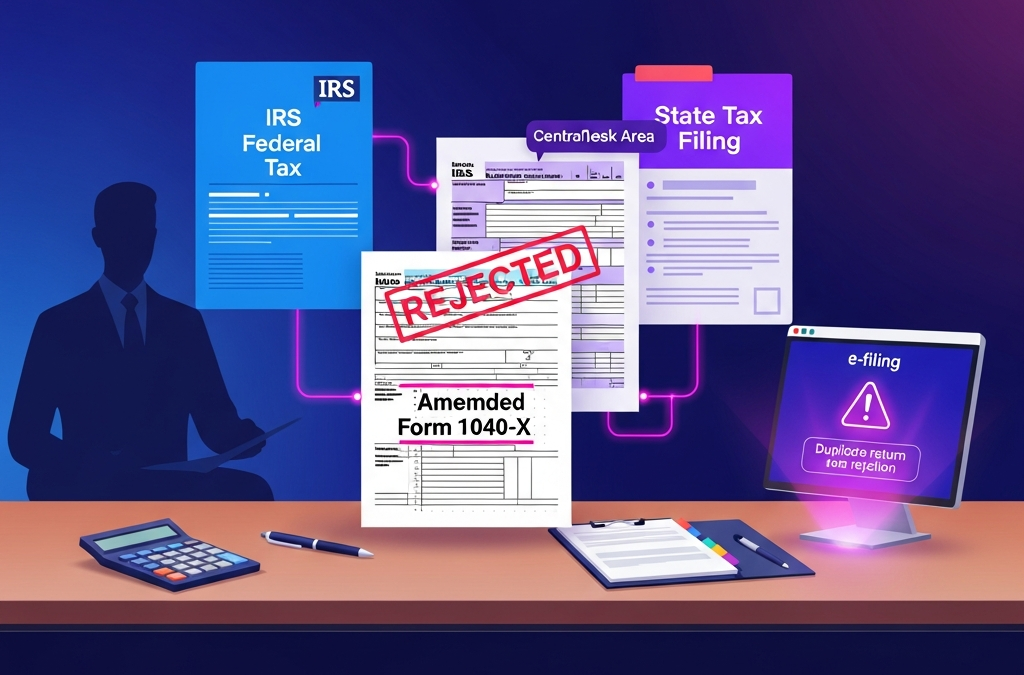
Navigating the complexities of tax season often leads to questions about proper filing procedures and what constitutes a legitimate tax submission. Many individuals wonder, “Can I file two tax returns?” The short answer, concerning primary federal income tax returns for the same period and taxpayer, is generally no, and attempting to do so can lead to significant issues with the Internal Revenue Service (IRS).
Key Takeaways
- One Primary Federal Return: For any given tax year and taxpayer identification number (TIN), only one original federal income tax return (e.g., Form 1040) should be filed.
- Amended Returns are Different: If corrections are needed after an original return is filed, an amended return (Form 1040-X) is the proper mechanism, not a second original filing.
- Legitimate Multiple Filings: Filing multiple state tax returns, business returns, or returns for different tax years are legitimate scenarios and distinct from filing two federal individual returns for the same year.
- Penalties for Duplication: Submitting duplicate original federal returns can trigger IRS flags, delays, and potential penalties for improper filing or even fraud if intent is suspected.
- Professional Guidance is Key: When uncertain, consulting a qualified tax professional is the best way to ensure compliance and avoid costly mistakes.
- Voice Search Relevance: People often ask, “Hey IRS, what if I accidentally filed twice?” or “Is it okay to file another tax return if I made a mistake?” The answer emphasizes correction through amendment, not duplication.
Understanding Tax Return Filing: Rules and Exceptions
The Fundamental Rule: One Primary Federal Return
For most U.S. taxpayers, the bedrock principle of federal income tax filing is straightforward: one person, one primary federal income tax return per tax year. This ensures clarity, prevents double-claiming deductions or credits, and allows the IRS to accurately assess tax obligations. Deviating from this fundamental rule without proper understanding can lead to significant complications.
What Constitutes a “Tax Return”?
- Definition: A tax return is the formal documentation submitted to a tax authority (like the IRS) that reports income, expenses, and other relevant financial information to calculate an individual’s or entity’s tax liability.
- Primary Forms: For individuals, the primary federal income tax return is typically IRS Form 1040 (U.S. Individual Income Tax Return), or variations like 1040-SR for seniors. State tax returns (e.g., Form 502 in Maryland, Form IT-40 in Indiana) are separate but follow similar principles within their jurisdictions.
- Purpose: The return serves as a comprehensive snapshot of your financial year, detailing your earnings, deductions, credits, and ultimately, whether you owe more tax or are due a refund.
Why Duplicate Filing is Prohibited
- System Integrity: The IRS processing system is designed to handle one primary return per Social Security Number (SSN) or Individual Taxpayer Identification Number (ITIN) per tax year. Multiple identical submissions cause confusion and errors.
- Preventing Fraud: Allowing duplicate primary filings would create an easy avenue for tax fraud, enabling individuals to make conflicting claims, attempt to receive multiple refunds, or evade taxes.
- Processing Efficiency: Duplicate returns bog down the system, leading to delays for all taxpayers, especially those awaiting refunds.
Penalties for Intentional Duplicate Filing
- Immediate Red Flags: Submitting two identical or conflicting primary federal returns will immediately flag your account for IRS review.
- Delayed Processing and Refunds: Your legitimate return (if one exists) will be held up indefinitely as the IRS attempts to sort out the discrepancy.
- IRS Correspondence: Expect official notices requesting clarification. Ignoring these notices can escalate the situation.
- Penalties and Interest: If the duplication is deemed an error that leads to underpayment or misrepresentation, penalties for accuracy-related issues (e.g., substantial understatement of income tax) or failure to pay, along with interest, may apply.
- Potential for Fraud Charges: In severe cases, where intent to deceive or defraud is suspected (e.g., filing with different information to get a larger refund), criminal charges and substantial fines or imprisonment could be imposed.
Differentiating “Two Tax Returns” from Legitimate Multiple Filings
It’s crucial to understand the distinction between filing two identical or conflicting primary federal returns (which is generally prohibited) and legitimate scenarios where taxpayers might submit multiple different tax documents or returns to various authorities.
Original vs. Amended Returns (Form 1040-X)
- Original Return: This is your first official submission for a given tax year, reporting your initial assessment of income and tax liability.
- Amended Return (Form 1040-X): This form is specifically designed to correct errors or update information on an already filed original federal income tax return. It is not a second original return but rather a modification to the first. Filing Form 1040-X is the correct way to make changes.
- Distinction: An amended return explicitly references and modifies the original filing, whereas a duplicate original filing presents itself as a brand new, independent submission for the same period.
Federal vs. State Tax Returns
- Separate Entities: The federal government (IRS) and individual state governments are separate taxing authorities. Most U.S. taxpayers with income are required to file a federal return and, if applicable, one or more state income tax returns.
- Distinct Obligations: Filing a federal Form 1040 and a state income tax return (e.g., California Form 540) are entirely separate obligations. These are not considered “two tax returns” in the problematic sense, but rather two different returns for different jurisdictions.
- Interdependence: While separate, state returns often use information from your federal return as a starting point.
Multimodal Suggestion: Table comparing Federal vs. State returns outlining key differences in scope and forms.
| Feature | Federal Income Tax Return (IRS) | State Income Tax Return (e.g., California FTB) |
|---|---|---|
| Authority | Internal Revenue Service (IRS) | Individual State Tax Agencies |
| Primary Form | Form 1040 | Varies by state (e.g., 540, IT-40, 760) |
| Scope of Income | U.S. and worldwide income of U.S. citizens/residents | Income earned/sourced within that specific state |
| Filing Frequency | Annual (unless specific circumstances) | Annual (unless specific circumstances) |
| Relationship | Often used as a basis for state calculations | Independent, but often linked to federal data |
Filing for Different Taxpayer Entities (e.g., Individual vs. Business)
- Individual Returns: These (Form 1040) report personal income, deductions, and credits.
- Business Returns: If you own a business, you might need to file separate business tax returns (e.g., Form 1120 for corporations, Form 1065 for partnerships, Schedule C for sole proprietors filed with Form 1040). These are distinct legal entities or reporting structures.
- No Conflict: Filing an individual Form 1040 and a business Form 1120 for a corporation you own are legitimate and required filings, not a problematic duplication.
Legitimate Scenarios for Multiple Tax Forms or Filings
While filing two identical primary federal returns for the same individual and year is a mistake, there are several legitimate and often required scenarios where taxpayers engage with multiple tax forms or file returns with different authorities.
Filing Amended Returns for Corrections
- Purpose: To correct errors, omissions, or report new information (like a late W-2, corrected 1099, overlooked deduction, or change in filing status) after the original return has been submitted.
- Process: Use Form 1040-X. This form explains the changes made and the reasons for them.
- Timeliness: File promptly upon discovering an error to avoid interest and penalties, especially if the change results in more tax owed.
Tax Obligations in Multiple States (Residency, Income Sourcing)
- Common Scenarios: This is frequent for people who:
- Moved states during the year.
- Live in one state but work in another (commuters).
- Own rental property or have business income in a different state.
- Sold assets in a state where they are no longer a resident.
- Filing Requirements: You might be required to file as a resident in one state and as a non-resident or part-year resident in another. Each state will have its own specific filing thresholds and forms.
- Avoiding Double Taxation: States typically offer credits for taxes paid to other states to prevent you from being taxed twice on the same income. Understanding these credits is vital.
International Tax Filings for US Citizens Abroad
- Worldwide Income Taxation: U.S. citizens and resident aliens are generally taxed on their worldwide income, regardless of where they live or earn it.
- Foreign Tax Credit/Exclusion: To prevent double taxation, the IRS offers mechanisms like the Foreign Earned Income Exclusion (Form 2555) or the Foreign Tax Credit (Form 1116).
- FBAR Reporting: In addition to Form 1040, those with foreign financial accounts exceeding certain thresholds must file FinCEN Form 114 (Report of Foreign Bank and Financial Accounts, or FBAR) with the Financial Crimes Enforcement Network, not the IRS. (Multimodal Suggestion: Image context – a world map with arrows pointing to different countries representing international tax obligations).
Deceased Taxpayers: Final Returns
- Executor/Administrator Responsibility: When an individual passes away, a final Form 1040 must be filed for the tax year of their death, reporting all income earned up to the date of death.
- Estate/Trust Returns: If the deceased had an estate that generates income, the executor might also need to file an estate income tax return (Form 1041, U.S. Income Tax Return for Estates and Trusts) in addition to the final individual return. These are different taxpayer entities.
Separate Returns for Married Couples (MFJ vs. MFS)
- Married Filing Jointly (MFJ): Most married couples choose this status, combining their income and deductions on a single Form 1040.
- Married Filing Separately (MFS): In certain situations (e.g., significant medical expenses for one spouse, desire for independent tax liability, domestic violence, or issues with a spouse’s tax history), couples may choose to file separate Form 1040s. Each spouse files their own return, reporting their individual income, deductions, and credits.
- Important Considerations: While legitimate, MFS often results in a higher overall tax liability and restricts access to certain credits and deductions compared to MFJ. It’s crucial to analyze both options before choosing MFS.
Filing for Prior Tax Years (Delinquent Returns)
- Non-Filing: If you failed to file a tax return for a previous year for which you had a filing requirement, you must submit that delinquent return. This is not filing a “second” return for the current year but rather fulfilling an overdue obligation for a past year.
- Statute of Limitations: While the IRS generally has three years to audit or assess additional tax, there is no statute of limitations for assessing tax if a required return was never filed, or if a fraudulent return was filed. Filing delinquent returns is crucial for compliance.
The Amended Tax Return: Your Correction Mechanism
When an error is discovered on a filed federal income tax return, the solution is not to refile the original, but to submit an amended return using Form 1040-X. This is a critical distinction for compliant tax behavior.
When to File Form 1040-X
- Reporting Additional Income: You received a corrected W-2, 1099, or realized you forgot to include certain income.
- Claiming Missed Deductions/Credits: You overlooked eligible deductions (e.g., student loan interest, IRA contributions) or credits (e.g., child tax credit, education credits).
- Correcting Filing Status: You initially filed with the wrong status (e.g., Single instead of Head of Household).
- Changes in Dependents: A dependent was incorrectly claimed or omitted.
- Investment Income Adjustments: Changes to capital gains/losses, dividends, or interest income.
How to File an Amended Return
- Form 1040-X: This form requires you to show the original amounts, the net change (increase or decrease), and the corrected amounts for your income, deductions, and credits. You also need to explain why you are amending the return.
- Paper Filing: As of now, Form 1040-X generally cannot be e-filed and must be mailed to the IRS. It’s important to send it to the correct IRS address, which varies by state.
- Supporting Documentation: Attach any new or corrected forms (e.g., W-2c, corrected 1099, receipts for new deductions) that support your changes.
- Timing: Wait until your original return has been processed by the IRS before filing Form 1040-X. This usually takes 2-3 weeks.
Common Reasons for Amending a Return
- Receiving a corrected information statement (W-2c, 1099-MISC, etc.) after filing.
- Realizing an eligible deduction or credit was overlooked.
- Mistakes in reporting income or expenses.
- Changes in marital status or number of dependents that affect tax liability.
Deadlines and Statute of Limitations for Amendments
- General Rule: You generally have three years from the date you filed your original return or two years from the date you paid the tax, whichever is later, to file Form 1040-X to claim a refund.
- Additional Tax Owed: If your amendment results in more tax owed, you should file and pay as soon as possible to minimize interest and penalties. The three-year rule for refunds does not limit the IRS’s ability to assess additional tax.
- Special Circumstances: Exceptions exist for certain situations, such as bad debts, worthless securities, or certain tax-related litigation, which may extend the amendment period.
Navigating Multi-State Tax Obligations
Dealing with income earned or residency in more than one state is a common scenario that legitimately requires filing multiple state tax returns. This complex area demands careful attention to state-specific rules.
Understanding Residency vs. Non-Residency
- Resident: Generally, the state where you live and have your permanent home for the majority of the tax year. Residents are typically taxed on all their income, regardless of where it was earned.
- Non-Resident: A person who lives in one state but earns income from sources within another state. Non-residents are usually only taxed by the non-resident state on the income sourced within that state.
- Part-Year Resident: Someone who moves from one state to another during the tax year, being a resident of each for a portion of the year.
Reciprocal Agreements Between States
- Purpose: Some neighboring states have reciprocal agreements to prevent commuters from being double-taxed on wages. Under these agreements, you typically only pay state income tax to your state of residency.
- Common States: Examples include Pennsylvania/New Jersey, Ohio/Kentucky, Indiana/Illinois, among others. These agreements usually apply only to wage income.
- Form W-4: If you work in a reciprocal state, you usually fill out an exemption form with your employer to prevent them from withholding taxes for the work state.
Credits for Taxes Paid to Other States
- Mechanism to Avoid Double Taxation: Most states offer a tax credit for income taxes you paid to another state on the same income. This prevents a taxpayer from paying full tax on the same income to two different states.
- Calculation: The credit is usually limited to the amount of tax you would have paid to your home state on that income, or the actual tax paid to the other state, whichever is less.
- Importance: Claiming this credit correctly is vital for minimizing your overall state tax burden. Failing to do so can result in overpaying your taxes.
Professional Guidance for Complex Multi-State Scenarios
- Complexity: Multi-state tax situations can be highly complex, especially with differing state tax laws, income sourcing rules, and credit calculations.
- Expertise Needed: A tax professional specializing in multi-state taxation can ensure all necessary returns are filed, credits are correctly claimed, and compliance is maintained across all relevant jurisdictions.
What Happens If You Accidentally File Two Identical Returns?
Accidental duplicate filings, while rare, do happen (e.g., hitting “submit” twice, tax software glitch, mailing a paper copy after e-filing). It’s crucial to know how to react promptly and correctly.
Identifying a Duplicate Filing
IRS Confirmation: You might receive two separate IRS confirmations if e-filing (unlikely for identical federal returns, but possible for state and federal).
- Refund Delays: A primary indicator will be unusual delays in your refund or unexpected correspondence from the IRS.
- IRS Tools: Use the IRS “Where’s My Refund?” tool. If it shows conflicting information or status, this could be a sign.
Immediate Steps to Take
- Do Not File a Third Return: Resist the urge to try and “fix” it by filing another return.
- Contact the IRS: The most direct action is to call the IRS directly. Be prepared with your SSN, filing status, and details of both submissions (dates, confirmation numbers if e-filed).
- Explain the Error: Clearly explain that an accidental duplicate filing occurred and you need guidance on how to proceed. Emphasize it was an error, not an attempt to defraud.
- Follow IRS Instructions: The IRS agent will advise you on the next steps, which may include sending a letter explaining the situation or simply waiting for their system to reconcile the issue.
Potential IRS Response and Resolution
- System Flags: The IRS system will likely flag both returns as duplicates or conflicting.
- Manual Review: Your case will probably be sent for manual review by an IRS agent.
- Correspondence: You may receive notices (e.g., CP05, CP2000) requesting clarification or notifying you of discrepancies.
- Resolution: The IRS will typically process one as the official return and disregard the other. However, this process can cause significant delays in receiving any refund or processing your legitimate return. If there are differences between the two filings, they will likely choose the one most advantageous to the government or ask for clarification, which could lead to an audit.
Preventing Errors and Ensuring Compliance
Proactive measures are the best defense against filing errors and potential IRS complications. A disciplined approach to tax preparation can save time, stress, and money.
Double-Checking Information Before Submission
- Review All Entries: Before clicking ‘submit’ or mailing your return, meticulously review all income figures, deductions, credits, and personal information (SSN, names, addresses).
- Compare to Prior Year: Look at your previous year’s return for consistency, especially with recurring items like dependents, interest income, or property taxes.
- Spelling and Numbers: A simple typo in an SSN or bank account number for a refund can cause major headaches.
Utilizing Reputable Tax Software
- Guided Process: Quality tax software (e.g., TurboTax, H&R Block Tax Software, TaxAct) guides you step-by-step, minimizing omissions and calculation errors.
- Error Checks: Most software includes robust error-checking features that flag potential issues before submission.
- Audit Risk Reduction: Using software often results in more accurate returns, which can reduce your audit risk.
The Role of a Qualified Tax Professional
- Expertise: For complex situations (e.g., self-employment, multi-state income, significant investments, estate issues), a Certified Public Accountant (CPA) or Enrolled Agent (EA) offers invaluable expertise.
- Audit Support: Many professionals offer audit representation, providing peace of mind.
- Strategic Planning: Beyond compliance, they can help with tax planning to optimize your financial situation.
Organizing Tax Documents Throughout the Year
- Designated System: Keep a dedicated folder (physical or digital) for all tax-related documents (W-2s, 1099s, K-1s, receipts for deductions, charitable contributions, medical expenses).
- Timely Filing: As documents arrive (often in January and February), immediately place them in your tax folder.
- Prevents Omissions: A well-organized system ensures you don’t overlook any income sources or eligible deductions when it’s time to prepare your return.
Impact on IRS Processing and Audit Risk
Errors in tax filing, especially duplicate submissions, can have tangible negative consequences on how the IRS handles your return and perceives your compliance.
Delays in Refund Processing
- Manual Review: Any discrepancy, including duplicate filings, will pull your return from automated processing into a manual review queue.
- Extended Wait Times: This can significantly extend the time it takes to process your return and, consequently, delay any refund you are due, often by several weeks or months.
- Communication Lag: The IRS may need to send you correspondence, which adds further delays as you wait for letters and then respond.
Increased Scrutiny and Correspondence
- IRS Flags: Duplicate filings or major inconsistencies between submissions are clear red flags that alert the IRS to potential issues.
- Notices and Letters: Expect to receive official IRS notices requesting clarification, informing you of discrepancies, or indicating that your return is under review. Ignoring these is ill-advised.
- Documentation Requests: The IRS may ask for additional documentation to substantiate your claims on the legitimate return.
Avoiding Unnecessary Audits
- Accuracy is Key: Filing accurate and consistent returns significantly reduces your chances of an audit.
- Understanding Discrepancies: While an accidental duplicate might not directly trigger a full audit, it increases scrutiny. If the duplicates contained different information, this raises the audit risk significantly as the IRS will need to reconcile the conflicting data.
- Responding Promptly: If you do receive an IRS inquiry, responding accurately and promptly with all requested information can often resolve issues before they escalate to a formal audit.
Common Misconceptions About Tax Filings
Misinformation or misunderstandings about tax rules can lead to errors. Addressing common myths helps foster better compliance.
“More Returns Mean More Refunds”
False: This is a dangerous misconception. Filing multiple federal returns for the same year will not result in multiple refunds. Instead, it will likely lead to delays, IRS scrutiny, and potential penalties. The IRS is designed to track a single refund per taxpayer per year.
“Filing Two Federal Returns is Just a Mistake”
Nuance: While an accidental duplicate filing can happen and is often treated as a mistake, if the two returns contain different information in an attempt to manipulate the system (e.g., claiming different deductions on each), it can be viewed as an intentional misrepresentation or even tax fraud, with severe consequences.
“Ignoring IRS Notices”
Perilous: Many taxpayers panic and ignore IRS notices, hoping the issue will go away. This is a critical mistake. IRS notices are serious and require a timely response. Ignoring them can lead to escalating penalties, collection actions (wage garnishment, bank levies), or liens.
Key Entities and Forms Involved
Understanding the specific forms and entities helps demystify the tax filing process.
IRS Form 1040 (U.S. Individual Income Tax Return)
Primary Individual Return: The foundational form for U.S. individual taxpayers to report their annual income, deductions, and calculate their tax liability or refund. Multiple variations exist (e.g., 1040-SR for seniors).
IRS Form 1040-X (Amended U.S. Individual Income Tax Return)
Correction Form: Specifically used to correct errors on a previously filed Form 1040. It is a critical tool for maintaining compliance after an initial filing.
State Tax Forms (e.g., Form 502, Form IT-40)
Jurisdictional Forms: Each state with an income tax has its own unique forms for residents, non-residents, and part-year residents to report state-specific income and deductions.
Taxpayer Identification Number (TIN/SSN)
Unique Identifier: Your Social Security Number (SSN) or Individual Taxpayer Identification Number (ITIN) is your unique identifier for tax purposes. The IRS uses this number to track all your tax-related activity, making duplicate filings easily detectable.
- Entity Clarity: Ensures that all income and deductions are correctly attributed to one individual or entity.
Resources for Taxpayer Assistance
When in doubt, reliable resources are available to provide accurate information and support.
Official IRS Website and Publications
- Primary Source: IRS.gov is the most authoritative and up-to-date source for federal tax information, forms, and publications.
- Search Function: Utilize the search bar for specific topics or forms.
- Publications: IRS Publications (e.g., Pub. 17, Your Federal Income Tax) offer detailed guidance.
Multimodal Suggestion: Alt text for IRS website screenshot: “Screenshot of the official IRS.gov homepage, showing navigation to forms and publications.”)
Taxpayer Advocate Service (TAS)
- Independent Organization: TAS is an independent organization within the IRS that helps taxpayers resolve problems with the IRS and recommends changes to prevent future problems. They are your voice at the IRS.
- Eligibility: If you are experiencing economic harm, are facing an immediate threat of adverse action, or have not heard from the IRS by the date promised, TAS might be able to help.
Low Income Taxpayer Clinics (LITCs)
- Free or Low-Cost Help: LITCs provide free or low-cost assistance to low-income individuals who have a tax dispute with the IRS, or who need help understanding their tax responsibilities.
- Geographic Reach: These clinics are independent organizations and are located in every state.
Certified Public Accountants (CPAs) and Enrolled Agents (EAs)
- Qualified Professionals: CPAs are licensed accountants, and EAs are federally authorized tax practitioners who represent taxpayers before the IRS. Both are highly qualified to prepare returns and provide tax advice.
- Choosing a Professional: Look for credentials, experience, good reviews, and ensure they are up-to-date on current tax law.
Frequently Asked Questions About Multiple Tax Filings
Can I file a joint return and then a separate return?
No, you generally cannot. Once you file as Married Filing Jointly (MFJ) for a tax year, you cannot amend to Married Filing Separately (MFS) after the tax deadline (typically April 15th). The only exception is if you filed MFS, you can generally amend to MFJ within three years from the original due date of the return.
What if I filed with the wrong Social Security Number?
If you entered an incorrect SSN for yourself or a dependent, you must file an amended return (Form 1040-X) to correct the information. This is a crucial correction, as the IRS relies heavily on accurate TINs.
Can I file two tax returns if I have two jobs?
No, you consolidate all your income from all jobs (and other sources) onto a single Form 1040. You will receive a W-2 from each employer, and all these W-2s contribute to the total income reported on your one federal tax return.
Is filing an amended return considered filing a “second” tax return?
No, an amended return (Form 1040-X) is a correction to your original return, not a new, separate original filing. It explicitly refers to and updates the data from your initial submission.
What happens if I file both federal and state returns and forget one?
If you forget to file a required state return, that state’s tax authority will eventually send you a notice. You will then need to file the delinquent state return, likely incurring penalties and interest. If you forgot a federal return, the IRS will similarly notify you, potentially leading to significant penalties for failure to file.
How do I know if the IRS received my original return?
If you e-filed, you should receive an email confirmation that your return was accepted by the IRS. For mailed returns, use certified mail with return receipt to get proof of delivery. You can also use the IRS’s “Where’s My Refund?” tool, which will show your filing status if your return has been processed.
What is the difference between a duplicate return and an amended return?
Duplicate Return: An attempt to file a second, identical or conflicting original tax return for the same taxpayer and tax year. This is generally prohibited and causes IRS issues. Amended Return (1040-X): A specific form used to correct information on a previously filed original return. This is the legitimate way to make changes.
Can I file taxes for multiple years at once?
Yes, if you have delinquent tax returns for previous years, you should file them as soon as possible. Each year will require a separate Form 1040 for that specific tax year. This is not considered filing “two tax returns” for the same year, but rather fulfilling past obligations for different years.
Navigating the Complexities of Tax Filing with Confidence
Understanding the rules around tax return submissions is paramount for every taxpayer. While the idea of filing “two tax returns” typically refers to an impermissible duplicate federal filing, the nuances of tax law allow for various legitimate scenarios involving multiple forms and filings across different jurisdictions or for different purposes. The key distinction lies in whether you are submitting a primary, original federal income tax return more than once for the same period (which is generally prohibited) versus amending a prior return or fulfilling distinct obligations to different taxing bodies.
Emphasizing Accuracy and Compliance
Accuracy, honesty, and timely compliance are the cornerstones of responsible tax behavior. Proactively gathering documents, carefully reviewing entries, and understanding filing requirements for your specific situation are critical steps. Errors, even accidental ones, can lead to unnecessary stress, delays, and financial repercussions. The IRS system is designed to detect discrepancies, and it’s always better to address potential issues transparently rather than hoping they go unnoticed.
The Value of Professional Guidance
For any situation that extends beyond a straightforward single-state, single-income tax return—such as multi-state residency, international income, complex investments, or business ownership—the expertise of a qualified tax professional is invaluable. They can navigate the intricate web of tax laws, ensure you claim all eligible deductions and credits, and represent you effectively if issues arise. Investing in professional advice can often save you more in taxes and penalties than the cost of their services.
Final Thoughts on Responsible Tax Practices
Tax laws are dynamic, and staying informed is a continuous process. Utilizing available IRS resources, maintaining meticulous records, and seeking expert help when needed are fundamental practices for managing your tax obligations effectively. By adhering to the principle of one accurate, original federal return per year, and using proper channels for amendments or separate jurisdictional filings, taxpayers can approach tax season with confidence and ensure full compliance.