
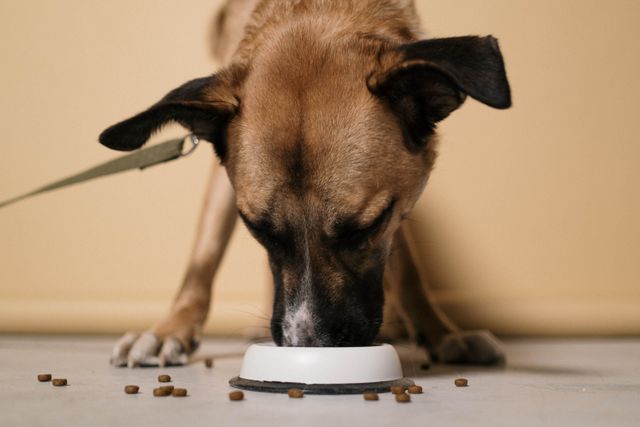
What does pumpkin do for dogs? Plain cooked pumpkin is mostly water and soluble fibre, so it adds bulk and moisture to a dog’s stool without adding many calories. Many vets suggest a spoonful to firm up mild loose stools or soften hard ones. It is a food, not a medicine.
Pumpkin has become the internet’s answer to every canine tummy problem, and most of what you will read is overstated. The honest version is narrower: a small amount of the right kind helps a healthy dog’s digestion at the margins, while the wrong kind — pie filling, a raw stalk, a week-old carved lantern — ranges from pointless to dangerous.
Key takeaways
- What does pumpkin do for dogs, in one line: it adds soluble fibre and water to the gut, bulking loose stools and softening hard ones.
- Use plain tinned purée or plain cooked fresh pumpkin. Never pie filling — it can contain xylitol, which is toxic to dogs.
- Start small: roughly a teaspoon per 5 kg of body weight, once a day, in a dog that is otherwise well.
- Plain unsalted seeds are not toxic, but they are fatty, a choking risk, and will not worm your dog.
- A rotting carved pumpkin is the real seasonal hazard — mould toxins can cause tremors within an hour.
- Pumpkin never replaces a vet once diarrhoea passes 24 hours, contains blood, or the dog seems unwell.
In this guide
- What does pumpkin do for dogs? The short answer
- What does pumpkin do for dogs day to day?
- Pumpkin, fibre and your dog’s gut
- How much pumpkin to give a dog
- Tinned, fresh, raw or pie filling
- Can dogs eat pumpkin seeds?
- Carved and rotting Halloween pumpkins
- When pumpkin is not the answer
- What most owners get wrong
- Example scenario
- Frequently asked questions
- Final verdict
What Does Pumpkin Do for Dogs? The Short Answer
Pumpkin flesh is roughly nine parts water to one part everything else, and the “everything else” includes soluble fibre, which absorbs water in the gut and forms a gel. That single property explains why pumpkin gets recommended for two opposite problems. In a loose stool it soaks up excess water and adds bulk. In a hard, dry stool it holds water in and makes the mass easier to pass.
What pumpkin does not do is treat anything. It does not kill worms, cure colitis or fix a food intolerance. Worth being clear-eyed here, because almost nobody else is: when the PDSA sets out what to feed a dog with diarrhoea, it names plain white rice and boiled chicken breast, or a tinned diet from a vet. Pumpkin is not on that list. That does not make it useless — it makes it a reasonable extra rather than the headline treatment it is usually sold as.
What Does Pumpkin Do for Dogs Day to Day?
Strip out the marketing and four benefits hold up for a healthy adult dog.
- Stool consistency. The soluble fibre effect above — the reason most owners reach for it, and the one most likely to show a result within a day or two.
- Extra moisture. Dogs on dry-only food take in little water with their meal. A spoonful of purée adds some back, which matters more in older dogs and reluctant drinkers.
- A low-calorie topper. A teaspoon stirred into food adds bulk for very few calories, keeping you inside the limit Dogs Trust sets for extras: “no more than 10 per cent of your dog’s diet should be made up of treats”.
- Beta-carotene. The orange pigment converts to vitamin A as the body needs it. Genuine, but minor — any complete food already supplies enough.
Notice what is absent: immune support, joint health, coat shine, anti-cancer effects. Those claims circulate widely and none has meaningful evidence behind it in dogs.
Pumpkin, Fibre and Your Dog’s Gut
Fibre comes in two types, and the difference decides whether pumpkin helps. Soluble fibre dissolves and gels, slowing transit slightly and firming loose stools — pumpkin’s fibre is largely this kind. Insoluble fibre does not dissolve; it adds rough bulk and speeds transit, and too much in an already irritated gut can make things worse. That is one reason the skin, stalk and leaves are a poor idea.
What does pumpkin do for dogs with diarrhoea?
In a dog that is bright, eating, drinking and otherwise well, a small amount of plain purée alongside a bland diet may help the stool firm up. The caveat is the clock. The PDSA advises contacting a vet as soon as possible once diarrhoea has lasted more than 24 hours, and sooner if the dog is very young or old, has another condition, or is on medication. Feeding pumpkin while that window closes is the commonest way this advice causes harm.
What does pumpkin do for dogs that are constipated?
The same gel holds water in a hard stool, but this is the weaker use — constipation in dogs often has a structural or painful cause rather than a dietary one. Gut blockages, swallowed bones, an enlarged prostate, arthritis and pelvic injury all sit behind it, and none is fixed by fibre.
The PDSA is blunt about home treatment here: laxatives should only be used “under advice from your vet”, and constipation “can get worse the longer you leave it”. A dog straining to pass anything needs examining, not a spoonful of squash.
How Much Pumpkin to Give a Dog
Once you know what does pumpkin do for dogs, dose is the next question — and more is emphatically not better. Too much fibre too fast produces wind, cramping and looser stools than you started with. The amounts below are a cautious starting point to discuss with your vet, not a prescription.
| Dog’s weight | Tinned plain purée, per day | Plain cooked fresh pumpkin |
|---|---|---|
| Under 5 kg | ½–1 tsp | 1–2 tsp mashed |
| 5–10 kg | 1–2 tsp | 2–3 tsp mashed |
| 10–20 kg | 2–3 tsp | 1–1½ tbsp mashed |
| 20–30 kg | 1–2 tbsp | 2–2½ tbsp mashed |
| Over 30 kg | 2–3 tbsp | 3–4 tbsp mashed |
Fresh cooked pumpkin holds more water than tinned purée, so the same effect takes a slightly larger spoonful. Start at the lower end of either column.
Introduce it as you would any new food. Dogs Trust recommends switching gradually over several days to a week, because sudden changes upset a dog’s stomach — advice that applies to a daily topper as much as to a new kibble.
Pet Care Tip
Freeze leftover purée in an ice-cube tray. One cube is roughly a tablespoon, so you get a measured dose and the tin does not sit in the fridge going off. Thaw before serving — a frozen cube is hard enough to risk a tooth.
Tinned, Fresh, Raw or Pie Filling
The answer to what does pumpkin do for dogs depends entirely on which pumpkin, and this is where nearly all the real risk sits.
| Form | Safe? | Why |
|---|---|---|
| Tinned plain pumpkin (100% pumpkin) | Best choice | One ingredient, consistent texture, easy to measure |
| Fresh, steamed or boiled, flesh only | Yes | Cook until soft, mash, no butter or salt |
| Pumpkin pie filling | Never | Sugar, spices and sometimes sweeteners — see the xylitol warning |
| Raw pumpkin flesh | Avoid | Hard, fibrous, poorly digested; defeats the purpose |
| Skin, stalk and leaves | No | Tough insoluble fibre; a swallowed stalk is a blockage risk |
| Carved or decorative pumpkin | Never | Mould, candle wax, paint and bacteria |
The xylitol point deserves spelling out, because it is the one that puts dogs in emergency clinics. Dogs Trust lists xylitol among the foods a dog must never eat, noting that “in dogs, xylitol can stimulate insulin release, leading to a dramatic crash in blood sugar levels”, and that it can also cause liver failure.
The same Dogs Trust list includes avocado, which is worth knowing if you have read our piece on whether avocado oil is good for a dog’s skin. Xylitol itself appears in sugar-free gum and sweets, some peanut butter, and some baked goods and sweetened fillings. If the tin lists anything other than pumpkin, put it back — and if you think your dog has eaten xylitol, ring your vet immediately rather than waiting to see how they look.
Can Dogs Eat Pumpkin Seeds?
The seeds are a separate question from what does pumpkin do for dogs, because they behave nothing like the flesh. Plain, unsalted pumpkin seeds are not toxic. That is the honest answer, and three things qualify it.
They are fatty. Seeds are calorie-dense, and a handful can upset a sensitive dog or one prone to pancreatitis. A few, not a scoop.
Whole seeds are a choking and obstruction risk, particularly in small dogs and in dogs that swallow without chewing. If you feed them, roast them plain and grind them.
Salted, spiced or shop-roasted seeds are out. The coating is the problem, not the seed. Salty foods in quantity are harmful, and shop packets often carry garlic or onion powder — both toxic to dogs.
Do pumpkin seeds worm a dog?
No, and this myth is worth killing properly, because believing it leaves worms untreated. The claim rests on cucurbitacin, a compound in the seeds that has shown some paralysing effect on parasites in laboratory settings. There is no reliable evidence it clears an established worm burden in a pet dog at any amount you could sensibly feed.
The PDSA is direct about the alternative: it recommends a prescription wormer covering the worms relevant to your dog, because these are “far more reliable than non-prescription products”, and says of home remedies plainly that they are “very unlikely to work”. Adult dogs usually need worming every one to three months, and lungworm needs covering as well as gut worms. No quantity of seeds does that job, and a dog on a seed regimen is a dog with no lungworm protection at all.
Carved and Rotting Halloween Pumpkins
Every October a dog gets into the jack-o’-lantern on the doorstep and the owner assumes pumpkin is pumpkin. Whatever pumpkin does for dogs in a bowl, a carved one left out for days is a different object — warm, wet, cut open and colonising mould.
Animal PoisonLine warns that mouldy food and mouldy plant material can contain tremorgenic mycotoxins, and that affected pets “may become ill very quickly, often within one hour”. Signs include vomiting, wobbliness, tremors, agitation, a high temperature and panting; severe cases can involve convulsions, effects can last several days, and deaths have occurred. Even slightly mouldy material could make a pet unwell.
If your dog has eaten mouldy material, ring your vet straight away rather than waiting for signs, and do not try to make your dog vomit at home — Animal PoisonLine warns this “could cause serious complications”. If you are unsure whether a trip to the vet is needed, Animal PoisonLine takes owner calls on 01202 509 000, charged at £35 between 8am and 8pm on weekdays and £45 at all other times.
A lantern also carries candle wax, tealight metal, paint or glitter alongside the mould. Treat it as a decoration and a bin item, never a snack.
When Pumpkin Is Not the Answer
There is a point where what does pumpkin do for dogs stops being the useful question. Call your vet rather than reaching for the tin if your dog shows any of the following — these are the PDSA’s own reasons to make contact, and none is a job for a food.
- Diarrhoea lasting more than 24 hours
- Blood or mucus in the diarrhoea
- Severe or constant watery diarrhoea
- Vomiting alongside the diarrhoea
- Reduced appetite or lethargy
- A painful stomach — yelping when picked up, or a hunched “prayer position”
- Any diarrhoea in a puppy, a very old dog, a dog on medication, or one with an existing condition
- Straining without passing anything, which can point to a blockage
Questions to ask your vet about pumpkin
- Given my dog’s weight and diet, how much purée is sensible as a daily topper?
- Does it interact with anything my dog takes, or with a prescription diet?
- My dog has had loose stools before — is added fibre right, or should we look at the cause?
- Would a proper fibre supplement or a prescription gastrointestinal diet do this better?
- How long should I give it before concluding it is not working?
What Most Owners Get Wrong
Knowing what does pumpkin do for dogs makes the failure modes easier to spot. The deepest is category confusion: pumpkin gets treated as a remedy, and remedies get a grace period — you give it, you wait, you give it again. Food does not earn that patience. A dog with worsening diarrhoea on day three of pumpkin has lost two days against the PDSA’s 24-hour threshold, and what changed is not the stool but the dog’s hydration.
| Mistake | Why it happens | Effect on the dog | How to avoid it |
|---|---|---|---|
| Grabbing pie filling | Both tins say pumpkin | Sugar, spices, possible xylitol exposure | Check the ingredients read “pumpkin” and nothing else |
| Too much, too soon | “It’s only a vegetable” | Wind, cramping, looser stools | Start at the low end of the chart; build over days |
| Waiting it out | Expecting a remedy to take time | Dehydration; a real cause left untreated | Hold to the 24-hour rule whatever you are feeding |
| Using seeds as a wormer | Widely repeated online | Worms left untreated; lungworm missed | Use a vet-recommended prescription wormer on schedule |
| Letting the dog at the lantern | It is “just pumpkin” | Mould toxins, tremors, wax and metal | Keep carved pumpkins out of reach; bin them early |
| Ignoring the 10% limit | Toppers feel like they do not count | Unbalanced diet; creeping weight gain | Count it as a treat and trim the meal to match |
Example Scenario
Illustrative example, not a real owner or dog.
Hannah’s eight-year-old labrador, Boe, has soft stools on a Friday after scavenging on walks. He is bright, eating and drinking well. Hannah searches “what does pumpkin do for dogs”, reads that it firms things up, and stirs two tablespoons of plain tinned purée into his breakfast — at 32 kg that sits at the lower end of the chart for his size. By Saturday evening the stool is forming better. She keeps the same amount on Sunday rather than increasing it, and by Monday Boe is normal.
Now change one detail. Suppose on Saturday morning Boe is also off his food and there is a streak of blood in the stool. The pumpkin becomes irrelevant — those are two of the PDSA’s reasons to contact a vet, and the right move is a phone call, not a second spoonful. Knowing which Saturday you are in is the whole skill.
Frequently Asked Questions
Can dogs eat pumpkin every day?
A small daily amount of plain purée suits most healthy adult dogs, provided it stays inside the 10% of the diet Dogs Trust allows for treats and extras. If you are feeding it daily to manage a recurring stool problem, see your vet about the cause.
How long does pumpkin take to work on a dog?
Owners often report firmer stools within 24 to 48 hours. If nothing has changed after a day or two, or your dog gets worse at any point, contact your vet. Pumpkin is not a treatment, so a lack of response tells you something else is going on.
Is tinned or fresh pumpkin better for dogs?
Tinned plain pumpkin is usually better: one ingredient, consistent in texture and easy to measure. Fresh works too, provided you cook it until soft and serve the flesh plain. Fresh holds more water, so the same effect needs a slightly larger spoonful.
Can dogs eat pumpkin skin?
Better not. The skin is tough insoluble fibre that most dogs digest poorly, and larger pieces can cause an obstruction. Peel it and feed the soft flesh only. The same applies to the stalk, which is hard enough to lodge in the gut.
What does pumpkin do for dogs with anal gland problems?
The theory is that bulkier stools press on the glands and help them empty naturally, and some vets do suggest added fibre for this reason. It is reasonable to try under veterinary guidance, but repeated anal gland trouble needs examining rather than self-managing with food.
Is pumpkin bad for dogs in any amount?
Plain pumpkin flesh is not toxic. The harm comes from the wrong form or quantity: pie filling with added sweeteners, salted seeds, raw stalks, mouldy carved pumpkins, or far too much fibre at once. Choose plain, start small, and the risk is very low.
What does pumpkin do for dogs that it cannot do for puppies?
Nothing different — the fibre works the same way. The issue is context: puppies on a complete growth food gain little from a topper, and loose stools in a puppy carry more risk of dehydration, so the threshold for calling the vet is lower rather than the pumpkin being unsafe. Diet is only one part of raising one well — our complete puppy training guide covers the rest.
Final Verdict: What Does Pumpkin Do for Dogs?
What does pumpkin do for dogs, in the end? It adds soluble fibre and water to the gut, which can firm a loose stool, soften a hard one and bulk out a meal for very few calories. Use plain purée or plain cooked flesh, start at roughly a teaspoon per 5 kg, keep it inside the 10% treat limit, and never let it delay a vet visit. A useful, cheap, single-ingredient extra — not medicine, not a wormer, and not a reason to wait.
Your next steps
- Check the tin in your cupboard. If the ingredients list anything beyond pumpkin, it is not the one to feed.
- Start at the low end of the chart for your dog’s weight and hold it there for two full days before deciding whether it is doing anything.
- If loose stools keep coming back, book the vet rather than restocking the purée. A recurring problem has a cause, and fibre is not it.
More dog and pet guides are in the Epiclectic pets section.
About the author — Written and reviewed by the Epiclectic Editorial Team. We check every guide against trusted UK animal-welfare and veterinary sources. This article is general information, not a substitute for professional veterinary advice. Always speak to your vet about your own pet’s health.
How we checked this guide: feeding, gut-health and worming guidance was checked against the PDSA Pet Health Hub (dog diarrhoea, dog constipation and worms in dogs), Dogs Trust (toxic foods, and diet and nutrition), and Animal PoisonLine (mouldy food and compost). We review this article every 12 months, or sooner if guidance changes.
Last reviewed: October 2026. Sources: PDSA, Dogs Trust, Animal PoisonLine.