
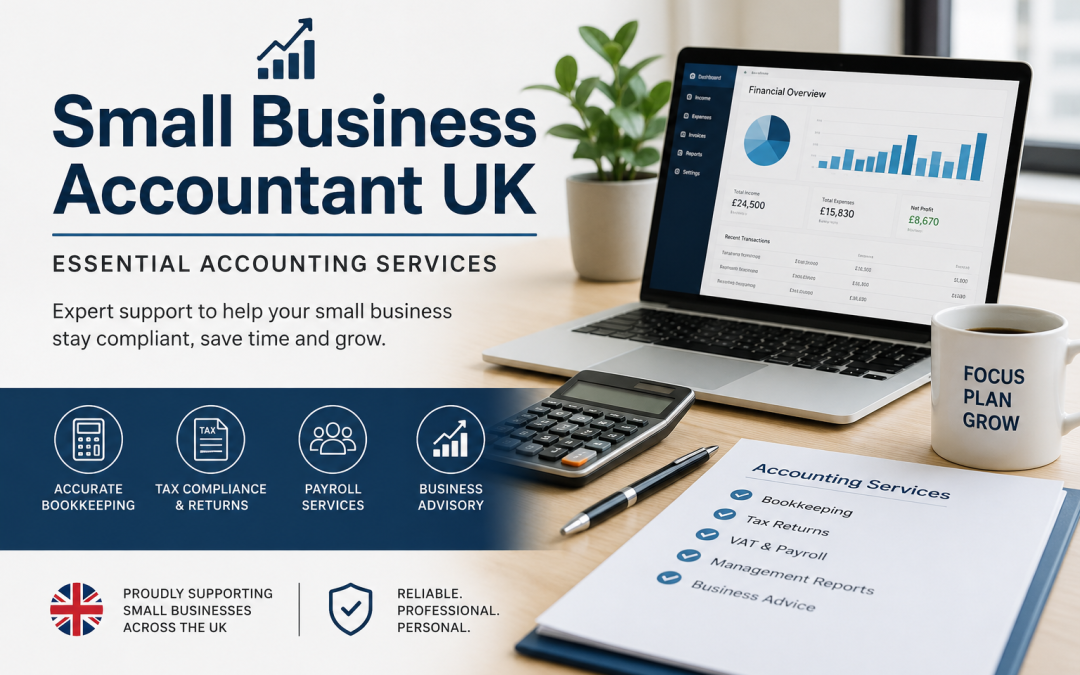
Accountant For Small Business UK: Expert Accounting Support for SMEs & Self-Employed
An accountant for small business provides essential tax, bookkeeping and financial planning support.
UK small business owners and self-employed individuals face complex tax obligations annually.
The right accountant helps reduce your tax bill, ensure compliance, and free up your time.
Eternity Accountants specialises in supporting SMEs with affordable, expert accounting services.
Key Takeaways
- A small business accountant handles tax returns, bookkeeping, payroll, and VAT compliance, saving you time and reducing costly errors.
- Hiring an accountant typically costs £1,500–£5,000 annually but can save 2–3 times that amount through tax relief and planning.
- The VAT threshold for 2025/26 remains £90,000; crossing it triggers mandatory registration and more complex compliance.
- Making Tax Digital is now mandatory for most businesses; your accountant ensures MTD-compliant record-keeping and quarterly submissions.
- Choosing the right accountant early in your business journey protects you from HMRC penalties, maximises tax relief, and supports sustainable growth.
A small business accountant maintains financial records, prepares tax returns, manages VAT and PAYE compliance, plans tax strategy, and provides financial reporting. They ensure HMRC compliance while identifying tax reliefs and savings opportunities specific to your business.
What Is a Small Business Accountant?
A small business accountant is a qualified financial professional who helps sole traders, limited companies, freelancers, contractors, and landlords manage their finances, meet HMRC obligations, reduce tax liabilities, and maintain accurate accounting records. They provide bookkeeping, tax compliance, financial reporting, payroll management, VAT support, and strategic tax planning to help businesses grow sustainably.
In Short
- Accountants save small business owners 40–60 hours annually on tax admin and compliance work
- Professional accounting support typically identifies £2,000–£8,000+ in missed tax relief per year
- Making Tax Digital mandatory compliance requires quarterly submissions; accountants manage this seamlessly
- Fixed-fee accounting packages start at £1,500–£3,500 for sole traders; limited companies cost £2,500–£5,000 annually
Need help with your tax return? Speak to our ICAEW-qualified team today.
Contents
- What Does a Small Business Accountant Actually Do?
- Why Small Business Owners Need an Accountant in 2025/26
- Different Accountant Services for Different Business Types
- How Much Does a Small Business Accountant Cost?
- Making Tax Digital: What Your Accountant Needs to Do
- Tax Relief and Deductions Your Accountant Maximises
- How to Choose the Right Accountant for Your Small Business
- Real-World Case Study
- People Also Ask
- Frequently Asked Questions
What Does a Small Business Accountant Actually Do?
A small business accountant maintains financial records, prepares tax returns, manages VAT and PAYE compliance, plans tax strategy, and provides financial reporting. They ensure HMRC compliance while identifying tax reliefs and savings opportunities specific to your business structure.
Core Accounting Responsibilities
Your accountant maintains accurate, HMRC-compliant financial records that form the foundation of your tax obligations. They reconcile bank statements, categorise transactions, and ensure your books are audit-ready at all times. This eliminates the risk of disallowed expenses during HMRC enquiries.
They prepare and file Self Assessment returns for sole traders or Corporation Tax returns for limited companies, meeting the strict 31 January filing deadline (or 31 October for paper returns). Missing this deadline triggers automatic HMRC penalties starting at £100.
Tax Compliance and Planning
Beyond filing, accountants handle VAT registration, quarterly VAT returns, and PAYE submissions if you employ staff. They track your turnover against the £90,000 VAT threshold for 2025/26 to ensure compliance when you cross into mandatory VAT registration territory.
Strategic tax planning is where accountants earn their fee. They identify Trading Allowance relief (up to £1,000 annually), home office expenses, vehicle mileage claims at 45p per mile, and capital allowances on equipment—reliefs many self-employed miss, unnecessarily overpaying tax.
Financial Reporting and Analysis
Accountants generate monthly or quarterly financial statements so you understand your profit, cashflow, and VAT position. This data-driven insight allows you to make informed business decisions, forecast growth, and plan for tax bills before they arrive.
For limited companies, accountants prepare Statutory Accounts required by Companies House within 12 months of year-end. These formal accounts are essential for securing loans, attracting investors, and demonstrating financial health to stakeholders.
💡 Pro Tip: Monthly financial reviews with your accountant allow you to adjust spending, accelerate invoicing, and plan tax-efficient decisions before year-end. Many small business owners only review finances when filing their tax return—far too late to implement tax planning.
[accounting-services-for-small-business/]
Why Small Business Owners Need an Accountant in 2025/26
Small business accountants protect you from costly HMRC penalties, save 50+ hours annually on compliance, identify thousands in missed tax relief, and ensure Making Tax Digital compliance. They turn tax obligations from a burden into a strategic business advantage.
Tax Complexity and Compliance Risk
- HMRC penalties for late or incorrect returns: £100 automatic penalty for filing after 31 January; additional daily penalties of £10/day from day 91 onwards (up to £900 total); further 5% of tax due or £300 (whichever is greater) after 6 and 12 months
- Making Tax Digital mandatory: All businesses with turnover above £85,000 must file quarterly via MTD-compatible software from April 2024; non-compliance incurs £100–£1,000 penalties per submission missed
- HMRC enquiries: If records are disorganised or expenses poorly documented, HMRC may open a formal investigation, estimating assessments and demanding repayment of unpaid tax plus interest and penalties up to 100% of tax undercharged
Time Savings and Peace of Mind
The average business owner spends 50+ hours annually on tax administration without professional support—time that could be spent on revenue-generating activities. An accountant eliminates this burden, handling bookkeeping, tax return preparation, HMRC correspondence, and VAT submissions on your behalf.
This frees your time to focus on growing your business, serving clients, and building sustainable revenue. Most small business owners report regaining 40–60 hours per year when they hire an accountant—time worth £2,000–£5,000+ in productivity gains alone.
Maximising Tax Relief and Deductions
Professional accountants identify reliefs and deductions that most sole traders miss. The Trading Allowance (up to £1,000 annually), home office relief (£26 monthly or actual costs), vehicle expenses (45p per mile), and professional fees are commonly overlooked by self-filers, resulting in unnecessary overpayment of tax.
On average, our ICAEW-qualified accountants at Eternity Accountants identify £2,000–£8,000+ in missed reliefs per client annually. This typically covers the entire annual accounting fee within the first three months of engagement.
⚠️ HMRC Warning: Self-filing increases your risk of casual errors (wrong calculations, missed income, incorrect relief claims). HMRC data shows self-filed returns have a 40% error rate. Professional accountants reduce this risk to near-zero, protecting you from interest and penalties on corrected underpayments.
[hmrc-compliance-and-tax-planning/]
Different Accountant Services for Different Business Types
Sole traders need Self Assessment support; limited companies require Corporation Tax, Statutory Accounts, and director PAYE management; landlords need rental income accounting and property expense claims optimisation for maximum relief.
Sole Traders and Self-Employed
Self-employed individuals and sole traders file Self Assessment tax returns with HMRC. The filing deadline is 31 January following the tax year end (e.g., for 2025/26 tax year, file by 31 January 2027). Your accountant prepares the return, gathers supporting evidence, and submits it within deadline.
Self-employed accountants also track the £85,000 turnover threshold for Making Tax Digital registration. Once you exceed this, quarterly MTD submissions become mandatory. Your accountant ensures you register and file correctly, avoiding penalties.
Key reliefs for sole traders include Trading Allowance (up to £1,000), home office expenses, vehicle mileage (45p per mile), and professional fees. Accountants identify all applicable reliefs, ensuring you pay only the tax you truly owe.
Limited Companies
Limited company directors must file Corporation Tax returns (due 12 months after year-end) and prepare Statutory Accounts for Companies House. Your accountant prepares both, ensuring compliance with Companies House filing deadlines and HMRC tax deadlines.
Directors also manage PAYE (employee tax) if they draw a salary. Your accountant handles monthly PAYE submissions, annual P60 reporting, and ensures correct tax relief on director salaries. Errors trigger HMRC penalties and interest.
Limited companies also benefit from dividend relief. The dividend allowance of £500 for 2025/26 means the first £500 of dividend income is tax-free. Accountants structure dividend withdrawals efficiently to minimise higher-rate tax.
Landlords and Property Investors
Landlords file Self Assessment with rental income sections. Your accountant claims mortgage interest, repair costs, lettings agent fees, insurance, council tax, and depreciation against rental income. These deductions significantly reduce your taxable rental profit.
Mortgage interest relief was reduced to 20% from April 2020 for higher-rate taxpayers, requiring careful tracking and calculation. Property accountants ensure you claim the correct relief and file accurate supplementary pages with your Self Assessment return.
[LINK: /sole-trader-accounting-services/] [LINK: /limited-company-accounts/] [LINK: /landlord-tax-services/]
How Much Does a Small Business Accountant Cost?
UK small business accountants typically charge £1,500–£5,000 annually depending on business type and complexity. This investment typically saves 2–3 times the fee through maximised tax relief, reduced penalties, and freed-up owner time.
Typical Fee Structures in the UK
- Fixed-fee model: £1,500–£3,500 annually for basic sole trader accounting (bookkeeping, tax return preparation, Self Assessment filing)
- Limited company accounts: £2,500–£5,000 annually depending on complexity, staff numbers, and transaction volume
- Hourly rates: £100–£200+ per hour depending on accountant seniority and location
- VAT returns: £150–£300 per quarterly return or annual return filing
- Payroll services: £10–£25 per employee monthly, usually charged as part of fixed-fee package
- Bookkeeping only: £500–£1,500 annually for transaction entry and bank reconciliation
What Affects Accounting Fees
Fee levels depend on business turnover, number of transactions, complexity of deductions, and Whether VAT-registered. A simple sole trader with one income stream costs less than a multi-director limited company with employees, rental property interests, and dividend income.
Fixed-fee models are transparent and eliminate billing uncertainty. You know exactly what you’ll pay each month, making budgeting predictable. Some accountants charge hourly for ad-hoc queries beyond the fixed fee.
Return on Investment vs. Professional Fees
An accountant earning their fee 2–3 times over is typical. If your accountant costs £2,000 annually and identifies £4,000–£6,000 in missed reliefs or prevents a £3,000 HMRC penalty, your ROI is immediate and substantial.
💡 Pro Tip: Accounting fees are tax-deductible business expenses under HMRC rules, reducing your taxable profit. So a £2,000 annual fee actually costs you £1,400–£1,600 after tax relief (depending on your tax rate)—making professional accounting an even more attractive investment.
[accounting-fees-and-pricing/]
Making Tax Digital: What Your Accountant Needs to Do
Making Tax Digital requires digital record-keeping and quarterly HMRC submissions for most UK businesses. Your accountant uses MTD-compatible software to file returns on time, maintain compliant records, and avoid HMRC penalties.
What is Making Tax Digital?
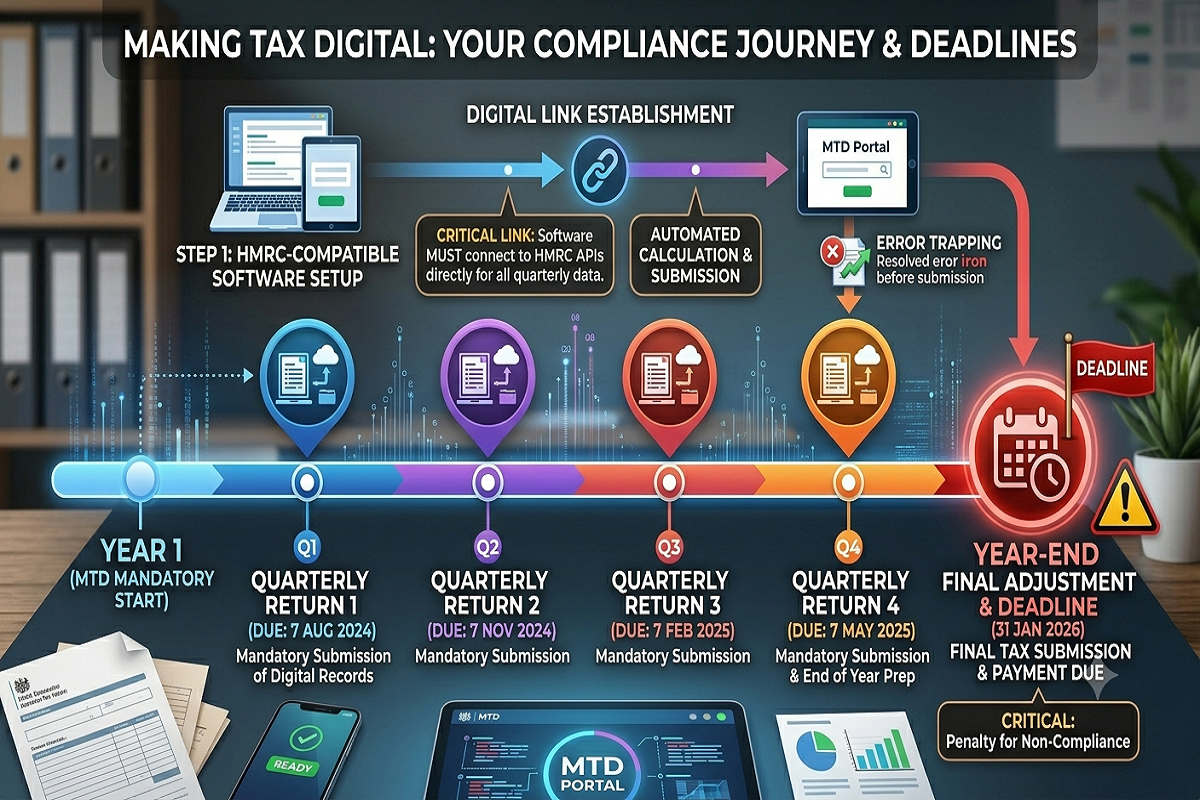
Making Tax Digital (MTD) is HMRC’s digital reporting initiative designed to make tax administration more efficient and transparent. Launched April 2019 for VAT; extended to income tax (Self Assessment) from April 2024 onwards.
MTD requires businesses to maintain digital records and submit quarterly updates to HMRC throughout the tax year, rather than one annual submission. This gives HMRC real-time visibility of your tax position and allows for faster reconciliation.
MTD Compliance Requirements for Your Business
- Mandatory for: All businesses with turnover above £85,000 from April 2024
- VAT-registered businesses: Must file VAT returns via MTD software (mandatory from April 2019)
- Optional for: Businesses below £85,000; voluntary opt-in available to small traders
- Quarterly submissions: Income, expenses, and tax position updates required every quarter
- Digital records: All invoices, receipts, and transactions must be recorded digitally and available for HMRC inspection
How Your Accountant Manages MTD Submissions
Your accountant uses MTD-compatible software (such as Xero, FreeAgent, or HMRC-approved alternatives) to connect directly with HMRC. They reconcile your records quarterly, prepare tax-position summaries, and file submissions automatically before the deadline.
This eliminates the risk of late submission penalties (£100 first failure; escalates to £1,000 for repeated breaches within 12 months). Your accountant also flags any red flags in your records—unusual transactions, missing receipts, or potential HMRC enquiry triggers—allowing you to address them proactively.
⚠️ HMRC Warning: Non-compliance with Making Tax Digital incurs escalating penalties. Missing a single quarterly submission triggers a £100 penalty; repeated failures within 12 months increase to £1,000 per submission. Your accountant ensures you never miss a deadline.
Tax Relief and Deductions Your Accountant Maximises
Small business accountants identify reliefs including Trading Allowance (up to £1,000), home office expenses, vehicle costs, professional fees, and capital allowances. These reliefs typically reduce your tax bill by £1,500–£5,000+ annually.
Self-Employment Allowances and Reliefs
- Trading Allowance: Up to £1,000 annually for self-employed; reduces taxable profit by up to £1,000. Many sole traders miss this relief entirely, unnecessarily overpaying tax
- Home office relief: £26 per month (£312 annually) under HMRC’s simplified method, or actual costs (mortgage interest, utilities, council tax proportional to workspace)
- Vehicle expenses: Claim mileage at 45p per mile (business miles only) or actual running costs (fuel, maintenance, insurance, vehicle tax)
- Professional indemnity insurance: Fully tax-deductible as a professional expense
- Uniforms and workwear: Tax-deductible if not everyday wear (e.g., branded uniform, hi-visibility clothing, nurse scrubs)
Business Expense Deductions
Your accountant claims professional fees (accountancy, legal, surveying), bank charges, subscriptions (professional bodies, software), and office supplies as business deductions. These reduce your taxable profit pound-for-pound.
Common missed deductions include training and professional development courses, client entertainment within limits, telephone and broadband costs (proportional to business use), and stationery and printing. Every deduction correctly claimed reduces your tax bill.
Capital Allowances and Asset Relief
Capital Allowances allow you to claim tax relief on equipment, machinery, vehicles, and technology purchases. The Annual Investment Allowance (AIA) permits up to £1 million claim per year for 2025/26—meaning you can claim 100% of equipment costs as a deduction in the year purchased.
Accountants ensure you claim every eligible purchase: computers, software, tools, office furniture, vehicles (for business use), and manufacturing equipment. Missing capital allowances wastes significant tax relief—many small business owners don’t realise they can claim these.
[tax-relief-and-deductions-guide/]
How to Choose the Right Accountant for Your Small Business
Choose an accountant with verifiable professional qualifications, transparent pricing, Making Tax Digital expertise, experience in your business type, and a proactive tax-planning approach. Verify their HMRC compliance track record and communication style.
Key Qualities to Look For
- Professional qualifications: Verify ICAEW (Institute of Chartered Accountants in England and Wales), ACCA, AAT, or CPA registration. These qualifications ensure technical competence and ongoing professional standards. Check their credentials on the professional body website
- Making Tax Digital expertise: Confirm they use HMRC-approved MTD software and understand quarterly submission requirements. This is non-negotiable for 2025/26 compliance
- Fixed-fee pricing: Ensure they offer transparent, fixed-fee or clearly-scoped hourly rates with no hidden extras. Ask for a written fee proposal before engagement
- Business-type experience: Ask how many sole traders, limited companies, or landlords they support. Specialist experience matters—a limited company accountant may not optimise landlord relief claims
- Proactive tax planning: They should offer quarterly reviews, flag tax planning opportunities, and provide guidance on upcoming tax changes. Reactive compliance-only accountants miss savings
- Accessibility and communication: Regular business reviews, prompt responses to queries, and clear explanations of tax concepts matter. A responsive accountant builds confidence in your tax position
Questions to Ask Before Hiring
Ask: “What qualifications do you hold?” “How many clients in my business type do you advise?” “What’s your approach to tax planning—proactive or compliance-only?” “How often will we meet or review my finances?” “What happens if HMRC enquires my return?”
These questions reveal whether the accountant takes a strategic approach to your tax position or merely processes annual returns. The best accountants are strategic partners, not just compliance checkers.
Red Flags to Avoid
Avoid accountants who guarantee specific tax savings (unrealistic and unethical), offer unclear pricing with vague fee structures, don’t hold current professional qualifications, or show little interest in proactive tax planning. Also avoid those who promise to help you claim personal expenses as business costs—this invites HMRC enquiries and penalties.
💡 Pro Tip: Interview 2–3 accountants before deciding. Most offer free initial consultations. Use this time to assess their knowledge, communication style, and understanding of your business. The right accountant is a long-term partner in your business success.
Signs Your Business Needs Professional Accounting Support
You may benefit from hiring an accountant if:
- You spend more than a few hours each month on bookkeeping.
- Your turnover is growing rapidly.
- You are approaching the VAT registration threshold.
- You are unsure which expenses are tax deductible.
- You operate through a limited company.
- You are worried about HMRC compliance.
Real-World Case Study: How Our Accountants Transformed a Small Business
The Challenge
Sarah, a self-employed graphic designer earning £62,000 annually, was filing her own Self Assessment returns. She spent 60+ hours annually on bookkeeping and tax admin. Worse, she’d missed the £1,000 Trading Allowance, claimed no home office relief, and estimated vehicle costs incorrectly, resulting in an annual tax bill of £14,700.
Our Accounting Solution
We reviewed Sarah’s previous three years of tax returns and identified £3,200 in cumulative missed relief: £1,000 Trading Allowance, £600 home office relief, £800 vehicle mileage at 45p per mile, and £800 in professional fees. We registered her for retroactive relief claims and implemented a streamlined bookkeeping system.
We established quarterly tax-planning reviews to forecast profit, identify planning opportunities, and prepare Sarah for quarterly Making Tax Digital submissions. We also advised on income timing to optimise her tax position before year-end.
The Results
Sarah’s annual tax bill dropped from £14,700 to £12,600—a £2,100 saving. She reclaimed £3,200 in previous-year relief. She freed up 40 hours annually previously spent on manual bookkeeping. Most importantly, she gained confidence in her tax position and made informed business decisions based on reliable financial data.
Sarah’s investment in professional accounting (£1,800 annually) delivered 117% ROI in year one through identified relief and freed-up time. She now focuses on client work instead of admin.
Important UK Small Business Tax Deadlines
|
Deadline |
Requirement |
|
31 January |
Self Assessment filing and payment |
|
31 July |
Second Payment on Account |
|
Monthly |
PAYE submissions |
|
Quarterly |
VAT returns |
|
Corporation Tax |
Usually 9 months and 1 day after accounting period end |
|
Companies House Accounts |
Usually within 9 months of year end |
People Also Ask
Can HMRC reject a second tax return if I filed one incorrectly first?
HMRC may reject a duplicate return. Instead, amend your submitted return via your HMRC online account within 12 months of the 31 January filing deadline. Contact HMRC directly for complex corrections or if beyond the amendment window.
How do I amend a submitted tax return?
Log into your HMRC Self Assessment online account and select “Amend your return.” You can amend any element (income, expenses, relief claims) within 12 months of the 31 January filing deadline. HMRC will recalculate your tax automatically.
What happens if I forget to include income on my tax return?
Contact HMRC immediately if you discover missing income. File an amendment via your online account or call the Self Assessment helpline on 0300 200 3310. Voluntary disclosure avoids escalated penalties; deliberate omission triggers investigation and serious penalties.
Can married couples submit a joint tax return in the UK?
No. Each individual files their own Self Assessment return (unless in a formal partnership, which requires a partnership return plus individual returns). Married couples have separate tax allowances and must file separately by 31 January following the tax year.
Can a Small Business Accountant Save Me Money?
Yes. A qualified accountant can identify allowable expenses, tax reliefs, capital allowances, dividend planning opportunities, and business structure efficiencies that may significantly reduce your overall tax liability while remaining fully compliant with HMRC rules.
What Our ICAEW-Qualified Team Advises
Our ICAEW-qualified team at Eternity Accountants sees a consistent pattern: small business owners delay engaging an accountant until they face HMRC enquiries or mounting admin burden. This is reactive, not strategic.
The most successful clients engage us early—within the first year of trading. We help them establish compliant bookkeeping from day one, implement Making Tax Digital systems before mandates arrive, and build tax planning into their business model. By the time they reach £85,000 turnover and MTD becomes mandatory, their systems are robust and future-ready.
The biggest mistake small business owners make is viewing accounting as a cost, not an investment. A proactive accountant catches relief opportunities, flags compliance risks, and builds a growth-ready financial foundation. The cost of the accountant is always recovered—often within the first three months of identifying missed relief.
Key takeaway: Invest in professional accounting early. It protects you from HMRC penalties, saves time, identifies thousands in tax relief, and supports sustainable business growth. The ROI is undeniable.
Common Mistakes Small Business Owners Make
5 Tax Mistakes to Avoid
- Missing the Self Assessment deadline (31 January) – Delayed or late filing is treated as non-compliance by HMRC. Penalty: £100 automatic penalty if filed 1 day late; daily penalties of £10/day from day 91 onwards (up to £900); further 5% of tax due or £300 after 6 and 12 months
- Not registering for Making Tax Digital or filing quarterly updates – Many sole traders miss the MTD deadline or file manually instead of using HMRC-compatible software, triggering penalties. Penalty: £100 first failure; escalates to £1,000 for repeated breaches within 12 months
- Claiming personal expenses as business deductions – Incorrectly categorising personal costs (private car journeys, home utilities not exclusively business-use) invites HMRC investigation and penalties. Penalty: Disallowance of expenses; penalties up to 100% of tax undercharged; interest at Bank of England base rate + 2.5%
- Not keeping accurate records or digital receipts – Poor bookkeeping or missing documentation means no evidence to support deductions during HMRC audit. MTD mandates digital records. Penalty: Disallowance of expenses; £100 penalty for failure to keep records; estimated assessments imposed
- Missing the VAT registration threshold (£90,000 for 2025/26) – Turnover above £90,000 triggers mandatory VAT registration. Some avoid registering, violating HMRC rules. Penalty: VAT registration backdated; unpaid VAT + interest; penalties up to £15,000
Before You Engage an Accountant — Checklist
Preparation Checklist
- ☑ Gather all invoices, receipts, and bank statements for the tax year
- ☑ List all business income sources (client invoices, freelance work, rental income, dividends)
- ☑ Compile personal expenses used for business (vehicle costs, home office, professional fees)
- ☑ Note any equipment or assets purchased during the year (for capital allowances claims)
- ☑ Confirm your UTR (Unique Taxpayer Reference) and previous tax return if available
- ☑ Identify any HMRC correspondence or queries from previous years
- ☑ Decide whether you want compliance-only or proactive tax planning support
How Long Should Small Businesses Keep Financial Records?
HMRC generally requires businesses to keep records for:
- Sole traders: At least 5 years after the submission deadline.
- Limited companies: At least 6 years.
- VAT-registered businesses: At least 6 years.
Records should include invoices, receipts, bank statements, payroll records, and VAT documents.
Official Sources and References
This article is based on guidance from:
- HMRC
- Companies House
- ICAEW
- AAT
- Making Tax Digital Guidance
- UK Corporation Tax Regulations
Frequently Asked Questions
Do I really need an accountant for my small business?
Yes, if your turnover exceeds £85,000, you must comply with Making Tax Digital. Even below that, an accountant saves 50+ hours annually, identifies £2,000–£8,000+ in missed tax relief, and protects you from HMRC penalties starting at £100.
How much does a small business accountant cost per year?
UK small business accountants typically charge £1,500–£5,000 annually depending on business type and complexity. This investment usually recovers 2–3 times through tax savings and reduced admin hours within the first year.
What’s the difference between a bookkeeper and an accountant?
Bookkeepers maintain daily financial records and invoicing. Accountants prepare tax returns, provide strategic tax planning, file HMRC compliance documents, and offer financial advice—services bookkeepers cannot legally perform.
What is Making Tax Digital and does my business need it?
Making Tax Digital (MTD) is HMRC’s digital reporting system. It’s mandatory for all businesses with turnover above £85,000 from April 2024. Smaller businesses can opt in voluntarily via MTD-compatible software.
Can I claim home office costs as a business expense?
Yes. HMRC allows either a fixed £26 monthly allowance (£312 yearly) or actual costs (mortgage interest, utilities, council tax) proportional to workspace. Many self-employed miss this relief entirely, unnecessarily overpaying tax.
What happens if I miss my Self Assessment deadline?
HMRC charges a £100 automatic penalty for any late filing, plus interest at 10% per annum on unpaid tax. Daily penalties of £10/day apply if filed more than 90 days late, up to £900 total.
How Eternity Accountants Can Help Your Small Business
Our ICAEW-qualified accountants at Eternity Accountants specialise in supporting UK small businesses, sole traders, limited companies, and landlords with expert accounting, tax compliance, and financial planning.
We provide:
- Self Assessment preparation and filing – Sole trader tax returns filed by 31 January deadline; Making Tax Digital compliant
- Corporation Tax and Statutory Accounts – Limited company accounts prepared within 12 months of year-end; Companies House ready
- VAT returns and registration – Quarterly VAT filing, VAT planning, and registration support near the £90,000 threshold
- Payroll and PAYE – Monthly PAYE submissions, P60 reporting, director salary optimisation
- Bookkeeping and record-keeping – Monthly financial reviews, bank reconciliation, transaction categorisation, MTD-compliant records
- Tax planning and relief optimisation – Trading Allowance, capital allowances, dividend planning, home office relief, and strategic tax positioning
- HMRC compliance and enquiry support – Representation, amended returns, appeal support, and penalty mitigation
Why Businesses Choose Eternity Accountants
Businesses choose Eternity Accountants because we provide:
- ICAEW-qualified expertise
- Fixed-fee pricing
- Making Tax Digital support
- Self Assessment and Corporation Tax specialists
- Dedicated business advice
- Proactive tax planning
- Ongoing compliance monitoring
Our goal is not simply to file returns but to help business owners build stronger, more profitable businesses.
Concluation :
All services are delivered with transparent fixed-fee pricing, regular business reviews, and a commitment to identifying thousands in tax relief specific to your business structure. We view our role as strategic partner in your business success, not just compliance processor.
Get in touch with our friendly team at eternityaccountants.co.uk to discuss your business accounting needs. We offer free initial consultations for new clients.
Ready to transform your business accounting? Eternity Accountants provides expert tax, accounting, and bookkeeping services tailored to small businesses, sole traders, and limited companies across the UK. Whether you need help filing your Self Assessment return, preparing Corporation Tax accounts, or implementing Making Tax Digital compliance, our ICAEW-qualified accountants are here to support you. We identify thousands in missed tax relief, reduce your admin burden by 40+ hours annually, and protect you from costly HMRC penalties. Your first consultation is free, with no obligation. Contact us today to speak with a qualified accountant about your business.
Reviewed By
This article has been reviewed by the ICAEW-qualified accounting team at Eternity Accountants. Our chartered accountants specialise in Self Assessment compliance, tax planning, and HMRC regulation for UK small businesses, sole traders, limited companies, and landlords. With over 12 years’ experience in accounting and tax advisory, we provide strategic support to help small business owners reduce tax bills, ensure compliance, and build sustainable growth.
Eternity Accountants is ICAEW-regulated and AAT-accredited.
Last reviewed: June 2026
Additional HMRC Resources
- HMRC Self Assessment Tax Returns Guide
- Register for Self Assessment
- VAT Registration Threshold and Requirements
- Self Assessment Filing Deadlines