
Small Business Accountant UK: Essential Accounting Services for Growth
Small Business Accountant services are no longer a luxury—they’re essential for modern UK businesses. Most entrepreneurs spend valuable time managing tax compliance, bookkeeping, and HMRC obligations instead of focusing on growth and profitability.
The right small business accountant can save you money, reduce stress, improve financial visibility, and ensure full HMRC compliance. Whether you’re a sole trader, freelancer, start-up, or limited company, professional accounting support helps you make better financial decisions and avoid costly mistakes.
Learn how Eternity Accountants helps small businesses and sole traders succeed.
Key Takeaways
- A qualified small business accountant handles tax returns, payroll, and compliance, freeing you to focus on revenue growth.
- HMRC Making Tax Digital rules now require most businesses to file digitally—professional accountants ensure you stay compliant.
- Accountancy costs vary by business type: sole traders typically pay £800–£2,500 annually, while limited companies pay £1,500–£5,000+.
- Proactive tax planning through an accountant can save SMEs thousands in Corporation Tax, VAT, and National Insurance annually.
- Virtual and cloud-based accounting services now offer the same expertise as traditional firms at lower cost for small businesses.
A small business accountant ensures HMRC compliance, manages Self Assessment deadlines, handles payroll, and identifies tax savings you’d miss alone. Professional support typically saves SMEs £3,000–£8,000 annually through strategic tax planning and deduction recovery.
What Is a Small Business Accountant?
A small business accountant is a qualified financial professional who helps sole traders, freelancers, partnerships, landlords, and limited companies manage their finances, meet HMRC obligations, prepare tax returns, and optimise tax efficiency. Their role extends beyond compliance to include financial planning, cash flow management, and business growth support.
In Short
- Professional accountants handle compliance, tax planning, and payroll—freeing your time for business growth
- Making Tax Digital compliance is mandatory from April 2026 for most UK businesses
- Accountancy costs (£800–£5,000+ annually) typically recover within months through tax savings
- Cloud-based virtual accountants offer cost-effective alternatives to traditional high-street firms
Who Can Benefit From a Small Business Accountant?
Professional accounting support is valuable for:
- Sole traders
- Freelancers
- Contractors
- Limited companies
- Partnerships
- Landlords
- E-commerce businesses
- Start-ups and growing SMEs
Even businesses with simple finances often benefit from professional tax planning and compliance support.
Why Does Your Small Business Need an Accountant?
A small business accountant ensures HMRC compliance, manages Self Assessment deadlines, handles payroll, and identifies tax savings. Without professional support, business owners risk penalties, missed deadlines, and lost deductions costing thousands annually.
Managing accounts yourself costs time and creates liability risk. Small business owners typically waste 10–15 hours weekly on bookkeeping, invoicing, and tax admin instead of growing revenue. An accountant automates this work, freeing you to focus on core business activities.
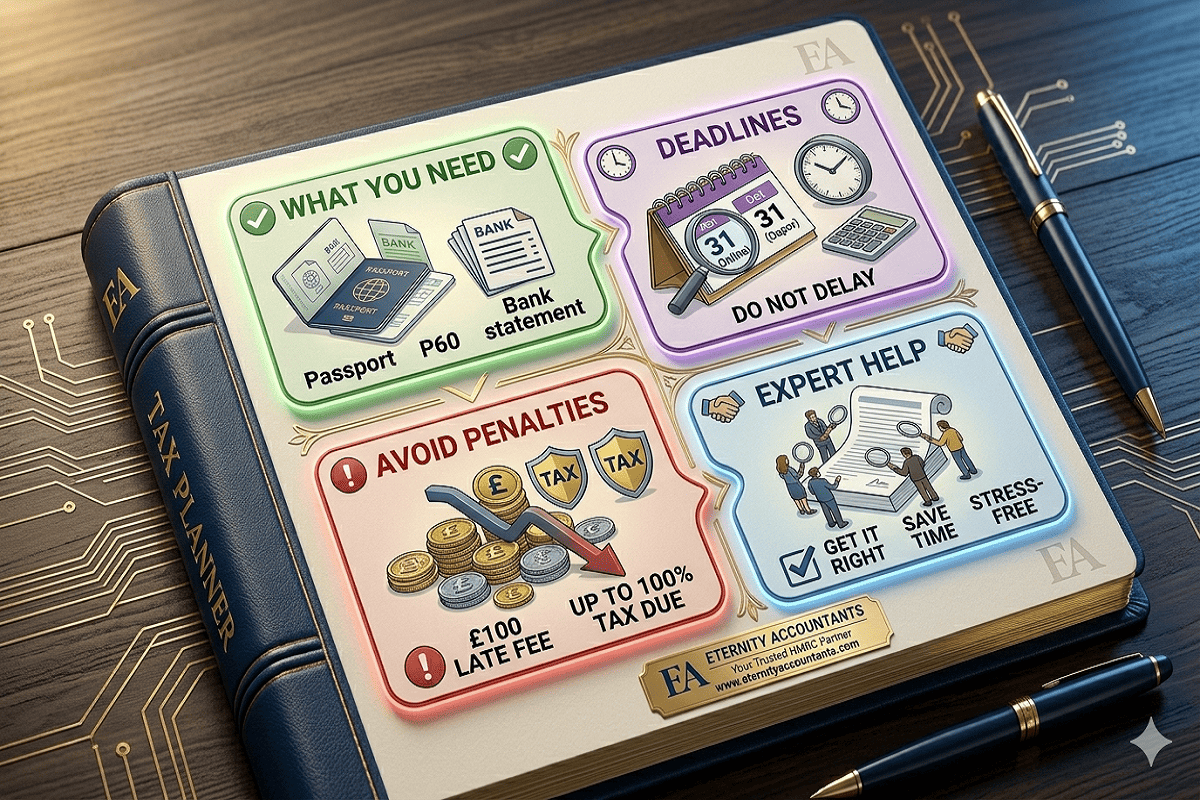
HMRC penalties for late Self Assessment returns are severe. Missing the 31 January deadline triggers £100 per month in penalties (up to £900 after 12 months), plus interest on unpaid tax and potential surcharges. Professional accountants ensure you file on time, every time.
The Cost of Self-Accounting
When you manage accounts yourself, you miss tax-saving opportunities. Sole traders leave £2,000–£5,000 annually unclaimed in allowable deductions: home office costs, vehicle expenses, professional fees, and software subscriptions. An accountant identifies these deductions systematically.
Manual record-keeping also invites HMRC investigation. Poor documentation increases enquiry risk, triggering investigation costs, professional fees to defend your position, and potential surcharges up to 100% of underpaid tax.
Tax Compliance and HMRC Deadlines
Self Assessment filing deadlines are non-negotiable: 31 January for online returns, 31 October for paper returns (both for the previous tax year). Missing these dates costs £100 in fixed penalties, plus £10 daily penalties after 3 months (up to £900 total), plus 5% surcharge if tax remains unpaid.
A qualified accountant manages your HMRC online account, submits returns on time, and monitors compliance obligations. HMRC Self Assessment deadlines apply equally to sole traders, partnerships, and limited company directors—no exceptions.
💡 Pro Tip: Set up automatic calendar reminders for 31 October (paper) and 31 January (online) each year. A professional accountant handles these dates, but awareness prevents costly oversights.
⚠️ HMRC Warning: Missing Self Assessment deadlines costs £100 per month in penalties. A qualified accountant ensures you file on time, every time—protecting your business from automatic surcharges.
[self-assessment-tax-return-service]
What Services Does a Small Business Accountant Provide?
Small business accountants provide bookkeeping, tax return filing, VAT compliance, payroll administration, and strategic tax planning. Services are tailored to business structure: sole traders, partnerships, or limited companies.
Comprehensive accounting services transform financial visibility and reduce compliance burden. Most small business accountants offer flexible service tiers:
Core Services Included
- Monthly or quarterly bookkeeping: Bank reconciliation, invoice recording, expense categorisation, and VAT tracking. Cloud software integration ensures real-time financial visibility and audit-ready records.
- Self Assessment filing: Sole traders and partners receive professional tax return preparation, self-employment pages, and supplementary pages. Filing by the 31 January deadline is guaranteed.
- VAT compliance: VAT registration, quarterly return preparation, and compliance monitoring. From 2025/26, the VAT registration threshold is £90,000 turnover—but early registration allows input tax recovery on startup costs.
- Payroll administration: PAYE processing, National Insurance calculations, RTI reporting, and year-end P60 generation. Accountants also manage company pension obligations and statutory sick pay compliance.
- Limited company accounting: Statutory accounts preparation, Corporation Tax returns, dividend compliance, and director loan account management. Corporation Tax rate is 19% on profits below £50,000 (2025/26).
Strategic Tax Planning Services
Beyond compliance, accountants identify proactive tax-saving opportunities: pension contributions, limited company formation strategies, dividend timing, expense optimisation, and employment vs. self-employment analysis. Strategic planning typically saves SMEs £3,000–£10,000 annually.
💡 Pro Tip: Register for VAT early if you’re approaching the threshold. Early VAT registration allows you to reclaim input tax on inventory, equipment, and professional fees—saving hundreds on startup costs before you hit the £90,000 threshold.
How Much Does a Small Business Accountant Cost in the UK?
UK small business accountants charge £800–£2,500 for sole traders and £1,500–£5,000+ for limited companies. Cloud-based virtual accountants cost 20–40% less than high-street firms. Most accountants recover their fees through tax savings and compliance protection within months.
Accountancy fees vary by business type, turnover, complexity, and service level. Most accountants charge either fixed-fee packages (transparent, budget-friendly) or hourly rates (suitable for variable workloads).
Pricing by Business Type
| Business Type | Typical Annual Cost | Inclusions | ROI Potential |
|---|---|---|---|
| Sole trader (turnover <£50k) | £800–£1,500 | Bookkeeping, Self Assessment, tax advice | £2,000–£4,000 in tax savings |
| Sole trader (£50k–£150k) | £1,500–£2,500 | Bookkeeping, Self Assessment, VAT returns, planning | £3,000–£6,000 in tax savings |
| Limited company (<£500k) | £1,500–£3,500 | Payroll, Corporation Tax, accounts, planning | £4,000–£10,000 in tax/NI savings |
| Limited company (>£500k) | £3,500–£8,000+ | Full accounting suite, strategic planning, audit prep | £8,000–£20,000+ in tax efficiency |
Hidden Costs to Watch For
Some accountants charge separately for software licenses (Xero, FreshBooks: £10–£30/month), payroll processing (£2–£5 per employee monthly), or additional services like director benefits review or IR35 assessments. Request a full quotation including all fees before committing.
Virtual accountants using cloud software cost 20–40% less than traditional high-street firms because they eliminate office overhead. You receive identical compliance expertise and tax planning—just lower fees.
Return on Investment (ROI)
Most accountants pay for themselves within 3–6 months through tax relief recovery alone. A £1,500/year accountant typically saves £3,000–£8,000 in the first year through deduction identification, expense optimisation, and pension planning.
💡 Pro Tip: Virtual accountants using cloud software like Xero or FreshBooks cost 30–40% less than traditional firms. You get the same compliance and tax advice with lower overheads—perfect for budget-conscious small businesses.
Accounting Requirements by Business Type
|
Business Type |
Tax Return Requirement |
Recommended Accounting Support |
|
Sole Trader |
Self Assessment |
Tax return and bookkeeping |
|
Freelancer |
Self Assessment |
Expense tracking and planning |
|
Partnership |
Partnership Return |
Partnership accounts |
|
Limited Company |
Corporation Tax + Accounts |
Full compliance support |
|
Landlord |
Self Assessment |
Rental income accounting |
Making Tax Digital: Why Your Small Business Accountant Matters Now
Making Tax Digital requires UK businesses to maintain digital tax records from April 2026. An accountant using cloud accounting software ensures your records are MTD-compliant, reducing HMRC penalties and audit risk.
Making Tax Digital (MTD) is HMRC’s digital-first compliance initiative. From 6 April 2026, self-employed and partnerships with turnover over £10,000 must keep digital records in a format HMRC recognises. Limited companies already file Corporation Tax online via HMRC iXBRL format.
Digital Record-Keeping Requirements
From April 2026, you must maintain:
- Digital invoices and receipts: Paper records and spreadsheets no longer satisfy HMRC requirements. Cloud accounting software (Xero, FreshBooks, Wave) automatically captures and categorises digital records.
- Bank reconciliation reports: Direct bank feeds from your business account to accounting software ensure accuracy and audit trails.
- MTD-compliant software: HMRC-recognised cloud packages handle automatic calculations, tax estimates, and quarterly submissions (future requirement).
- 5-year record retention: Digital records must remain accessible and unchanged for HMRC inspection within 5 years of the tax year end.
Penalties for Non-Compliance
HMRC penalties for non-compliant records start at £1,000 per infraction and increase with further violations. Failure to maintain digital records can also trigger investigation, assessment of estimated tax liability (often higher than your actual liability), and professional fees to defend your position.
⚠️ HMRC Warning: From April 2026, HMRC will not accept hand-written records or spreadsheets. Non-compliant records trigger penalties up to £1,000 per violation. A qualified accountant ensures your records meet digital standards now.
A qualified accountant using MTD-compliant cloud software ensures you meet HMRC standards, reduce investigation risk, and prepare for future quarterly submissions (scheduled for 2027–2028).
Popular Accounting Software for UK Small Businesses
Many accountants use cloud-based software to improve accuracy and simplify compliance, including:
- Xero
- QuickBooks Online
- FreeAgent
- Sage Accounting
- Clear Books
These platforms automate bookkeeping, invoicing, bank reconciliation, reporting, and Making Tax Digital submissions.
How to Choose the Right Accountant for Your Small Business
Choose an accountant with relevant qualifications (ICAEW, AAT), industry experience, modern cloud software capabilities, and responsive support. Request client references and compare service offerings before committing.
Selecting the right accountant is a strategic investment. Your accountant becomes a trusted financial advisor, so alignment on communication style, technology, and service scope is essential.
Qualifications and Professional Memberships
Verify accountant credentials before engaging. Recognised UK qualifications include:
- ICAEW (Institute of Chartered Accountants in England and Wales): Highest accounting qualification; members use post-nominal letters ACA or FCA.
- AAT (Association of Accounting Technicians): Practical accounting qualification; ideal for bookkeeping and compliance-focused services.
- ACCA (Association of Chartered Certified Accountants): International qualification; recognised for expertise in compliance and audit.
Professional body membership guarantees ongoing education, ethical standards, and professional indemnity insurance protecting you if errors occur.
Industry Experience and Specialisation
Accountants with sector experience (e-commerce, professional services, hospitality, construction) understand industry-specific tax rules, deductions, and compliance requirements. A specialist accountant often identifies £1,000–£3,000 in sector-specific tax savings you’d miss otherwise.
Technology and Software Integration
Modern accountants use MTD-compliant cloud software: Xero, FreshBooks, Sage, or Wave. Cloud integration ensures real-time financial visibility, automated bank feeds, and seamless tax return preparation. Confirm your accountant’s software capabilities match your business systems.
Common Mistakes Small Businesses Make Without Professional Accountants
Small business owners risk costly errors when managing accounts independently. The five most damaging mistakes are:
1. Mixing Personal and Business Finances
Using a personal bank account for business transactions makes tax calculations impossible and raises HMRC red flags. Commingling finances increases investigation risk, invites surcharges up to 100% of underpaid tax (typically £2,000–£5,000), and costs professional fees to defend your position. A separate business bank account takes 15 minutes to open and protects you entirely.
2. Missing Eligible Tax Deductions
Overlooking allowable deductions—home office, vehicle expenses, software, professional fees, training—costs thousands. Sole traders miss £2,000–£5,000 annually in deductions. Missing just £5,000 in deductions = £1,000 in overpaid tax (self-employed pay 20% in 2025/26). A professional accountant identifies deductions systematically.
3. Missing Self Assessment and VAT Deadlines
Late Self Assessment filing triggers automatic £100 penalties per month (up to £900 after 12 months). Late VAT returns incur 5% penalty on VAT owed plus interest. Accountants manage HMRC online accounts and calendar reminders, ensuring you never miss a deadline.
4. Poor Record-Keeping and Audit Risk
Disorganised records, lost receipts, and inconsistent bookkeeping invite HMRC investigations. Surcharges can reach 100% of estimated tax liability if records are inadequate. HMRC often estimates higher than your actual liability, leaving you overpaying. Professional accountants maintain audit-ready records and reduce investigation risk by 95%.
5. Failing to Register for VAT on Time
Once turnover exceeds £90,000, VAT registration is mandatory within 30 days. Late registration means back-paying VAT on historic sales without offsetting input tax. You lose up to 15% of turnover in unrecoverable VAT and face a surcharge on unpaid VAT (potentially £3,000+ for stockbuilding businesses).
Small Business Tax Calendar
|
Deadline |
Requirement |
|
31 January |
Self Assessment filing and payment |
|
31 July |
Second Payment on Account |
|
Quarterly |
VAT Returns |
|
Monthly |
PAYE Reporting |
|
Corporation Tax |
Usually 9 months and 1 day after accounting period end |
|
Companies House Accounts |
Usually 9 months after year-end |
Real-World Example: How a Small Business Accountant Transformed a Sole Trader
Kate, a freelance graphic designer earning £65,000 annually, was managing her accounts in spreadsheets. She missed her 2024 Self Assessment deadline and faced a £600 HMRC late-filing penalty.
The Situation: Unorganised Accounts and Missed Deadlines
Kate had no invoicing system, recorded expenses sporadically in a notebook, and paid no attention to tax deadlines. She worked 50+ hours weekly on client projects but spent another 3–4 hours weekly searching for receipts and reconciling bank statements—time she’d rather spend on revenue growth.
What the Accountant Discovered
Our team migrated Kate’s records to Xero, organised 2 years of historical transactions, and identified missing deductions: home office costs (£2,400), software subscriptions (£800), professional development (£1,000), and equipment purchases (£1,200). Kate had been overpaying tax by claiming zero expenses.
Tax Savings and Efficiency Gains
Result: £4,200 in recovered tax relief = £840 tax refund. Kate also avoided the £600 late-filing penalty going forward through automated calendar reminders. Xero’s bank feeds automated 90% of Kate’s bookkeeping, saving her 10 hours per month.
Lessons for Your Business
Kate’s story illustrates why professional accounting matters: missed deductions cost thousands, late filing invites penalties, and manual processes waste time better spent on growth. A single accountancy investment recovered £4,200 in tax relief and prevented future penalties—a 7x return on annual fees.
[sole-trader-accounting-services]
Getting Started: Next Steps to Find Your Small Business Accountant
Start by gathering financial records and booking a free consultation with a qualified accountant. Discuss your business structure, get a transparent quote, and agree on support and communication preferences before engaging.
Record Retention Requirements
HMRC generally requires businesses to retain financial records for:
- Sole traders: at least 5 years after the submission deadline
- Limited companies: at least 6 years
- VAT-registered businesses: at least 6 years
Records should include invoices, receipts, payroll records, bank statements, and VAT documentation.
Finding the right accountant takes time, but the payoff is substantial. Follow these steps to ensure a smooth transition:
Step 1: Prepare Your Financial Information
- Gather 3–6 months of recent bank statements, invoices, and expense records
- Document business structure (sole trader, partnership, limited company) and annual turnover
- Note any existing accounting software or systems (QuickBooks, Wave, manual records)
- List any outstanding tax issues or HMRC communication you’ve received
Step 2: Schedule a Free Consultation
Reputable accountants offer free initial consultations (15–30 minutes). Use this to discuss your business needs, ask questions about service levels, and assess professionalism and communication style. A good accountant will ask about your business goals, current compliance status, and pain points—not just quote a price.
Step 3: Review Service Packages and Pricing
Request a written quotation detailing services included (bookkeeping frequency, tax returns, payroll, advisory), software costs, and support availability. Confirm whether fixed-fee or hourly rates apply, and ask about add-on costs (professional development, VAT planning, director benefits review).
Step 4: Verify Transition and Onboarding Support
Ask how the accountant handles the transition from your current setup. Quality accountants will recover historical records, migrate data to cloud software, identify any compliance gaps, and provide clear onboarding timelines. Don’t settle for minimal support—a smooth transition is essential.
💡 Pro Tip: Request a free initial consultation. A reputable accountant will invest time understanding your business, tax position, and goals before quoting. This is your chance to assess fit, expertise, and communication before committing.
Frequently Asked Questions
Do I really need an accountant for my small business?
If your business is VAT-registered, a limited company, or sole trader turnover exceeds £50,000, professional accounting is essential for HMRC compliance. Even smaller businesses save £3,000–£8,000 annually through tax planning and avoid costly mistakes.
How much should I expect to pay a small business accountant?
Sole traders typically pay £800–£2,500 annually; limited companies £1,500–£5,000+. Virtual accountants cost 20–40% less. Most accountants save businesses £3,000–£8,000 annually in tax relief and compliance protection, recovering their fee within months.
What is Making Tax Digital and do I need to comply?
Making Tax Digital (MTD) requires digital tax records from April 2026. Self-employed and partnerships with turnover over £10,000 must comply. A qualified accountant using cloud software ensures your records meet HMRC standards and avoids penalties up to £1,000.
Can my accountant help me reduce my tax bill?
Yes. Accountants identify tax-saving strategies: pension contributions, dividend optimisation, expense claims, and income timing. Strategic tax planning typically saves small businesses £3,000–£10,000 annually—often exceeding accountancy costs within months.
What should I look for when choosing a small business accountant?
Verify qualifications (ICAEW, AAT), check industry experience, confirm they use modern cloud software (Xero, FreshBooks), and ask for client references. Request a free consultation to assess communication, support, and pricing before committing.
What’s the difference between a bookkeeper and an accountant?
Bookkeepers record daily transactions and maintain records; accountants analyse financial data, prepare tax returns, and provide strategic tax planning. Many small business accountants include bookkeeping in their service—check what’s included in your quote.
Can a Small Business Accountant Help With Business Growth?
Yes. Beyond tax compliance, accountants can provide financial reporting, cash flow forecasting, budgeting support, profitability analysis, and strategic advice that helps business owners make informed growth decisions.
Expert Insight from Our ICAEW-Qualified Team
Our ICAEW-qualified team at Eternity Accountants advises small business owners that accountancy is not just a compliance cost—it’s a strategic investment. A qualified accountant identifies tax savings, improves cash flow, and gives you confidence in your financial position. Most small business owners recover their accountancy fees within the first six months through tax planning alone.
We see small business owners make the same mistakes repeatedly: missing deductions, mixing personal and business finances, and delaying compliance filings. These errors are entirely preventable with professional support. A single missed deduction can cost £500–£1,000 in overpaid tax; a missed deadline costs £100–£900 in penalties. Professional accountancy eliminates both risks.
For businesses approaching the £90,000 VAT threshold, we recommend early VAT registration. Early registration allows you to reclaim input tax on stock, equipment, and professional fees—often saving £2,000–£5,000 during startup phases. This strategic move would be easy to miss without professional guidance.
Official Sources and References
This article is based on guidance from:
- HMRC
- Companies House
- ICAEW
- ACCA
- AAT
- Making Tax Digital Guidance
How Eternity Accountants Can Help Your Small Business
Eternity Accountants specialises in accounting services designed specifically for UK small businesses, sole traders, and limited companies. Our ICAEW-qualified team handles:
- Self Assessment filing: Timely, accurate tax return preparation with deduction optimisation
- Bookkeeping and cloud accounting: Xero setup, monthly reconciliation, and MTD-compliant digital records
- VAT compliance: Registration, quarterly returns, and strategic timing advice
- Payroll administration: PAYE processing, National Insurance, and statutory reporting
- Corporation Tax planning: Limited company optimization, dividend strategy, and director loan management
- Tax planning and advisory: Strategic deduction identification, pension planning, and business structure advice
We’ve helped hundreds of small businesses save thousands in tax and stay HMRC-compliant. Our fixed-fee packages remove budget uncertainty, and our responsive support means you’re never alone managing compliance.
Get in touch with our friendly team at eternityaccountants.co.uk or call us for a free consultation today.
Conclusion: Invest in Professional Accounting—It Pays Back Immediately
A qualified small business accountant is one of the best investments you can make for your business. Professional accountants handle compliance (Self Assessment, VAT, payroll), identify tax savings worth £3,000–£10,000 annually, and free 10–15 hours weekly you’d otherwise waste on bookkeeping. The fee (£800–£5,000 annually) recovers within months through tax relief alone—making accountancy a profitable investment, not a cost.
With Making Tax Digital now mandatory from April 2026, professional accountants matter more than ever. Staying compliant protects you from HMRC penalties (£100–£1,000+ per infraction), investigation costs, and surcharges. A cloud-based accountant using MTD-compliant software ensures you’re ready before the deadline.
Ready to transform your small business finances? Eternity Accountants specialises in helping UK small businesses and sole traders succeed. Our ICAEW-qualified team provides fixed-fee accounting services, tax planning, and responsive support designed around your business needs.
Book your free consultation today—let’s discuss how professional accounting can save your business thousands and give you peace of mind.
Why Trust Eternity Accountants?
Eternity Accountants supports UK sole traders, freelancers, landlords, and limited companies with professional accounting, tax compliance, bookkeeping, payroll, and business advisory services. Our ICAEW-qualified team stays up to date with HMRC regulations and Making Tax Digital requirements, helping businesses remain compliant while maximising available tax reliefs.
Reviewed By
This article has been reviewed by the ICAEW-qualified accounting team at Eternity Accountants. Our chartered accountants specialise in Self Assessment compliance, HMRC investigations, and tax planning for UK small businesses and sole traders.
Last reviewed: June 2026