

Written by Samina, Epiclectic Editorial Team · For small businesses in India · Last reviewed November 2026
Running a small business is not always easy. You need to look after customers, manage daily work and make sure your employees receive their salaries on time. Things become harder when employees do not all follow the same payment schedule.
Some employees receive their wages every week. Others are paid every two weeks. Full-time employees may receive their salaries once a month, and part-time workers may be paid based on the days or hours they work. When one small team handles all these different pay schedules, mistakes can happen: a payment is delayed, an employee receives the wrong amount, or the owner spends hours checking records before payday.
The good news is that small businesses can manage different pay schedules with a clear payment calendar, proper employee records and regular checks. Using HR payroll software solutions can also help businesses keep attendance, leave and salary information in one place, making it easier to prepare payments for different groups of employees.
Quick answer
Group employees by their pay schedule (daily, weekly, fortnightly or monthly), give each group its own payment calendar and attendance cut-off, keep all employee records in one place, and check attendance, leave and advances before every payment run. In India, the Code on Wages, 2019 also sets a payment deadline for each wage period, so build those dates into your calendar.
Why trust this guide
Legal points were checked on 20 November 2026 against the Code on Wages, 2019, the Ministry of Labour and Employment’s labour codes factsheet (PIB), the Income-tax Department, EPFO and ESIC. Examples are illustrative and were checked by the Epiclectic Editorial Team. Rules vary by state, so treat this as general information and confirm details with a chartered accountant or labour-law adviser.
1. Why do employees have different pay schedules?
Not every employee works in the same way. Think about a small business that has a retail shop, a warehouse and a delivery team. The retail shop may have full-time employees on monthly salaries, the warehouse may have workers on weekly wages, and delivery workers may be paid for the days they work.
All these employees are important to the business, but their payment needs are different. For example, a business may have:
- 10 full-time employees who receive monthly salaries;
- 5 part-time employees who receive weekly wages;
- 3 delivery workers who are paid fortnightly;
- 2 temporary workers who are paid after completing their assigned work.
This means the owner cannot follow one salary date for everyone. Each group needs a clear payment schedule, and understanding these differences is the first step towards making payroll for different pay schedules easier.
2. Understand the different types of pay schedules
Before preparing salary payments, business owners should understand how each payment schedule works. In India, the Code on Wages, 2019 allows the employer to fix a daily, weekly, fortnightly or monthly wage period, and no wage period can be longer than one month.
| Schedule | How it works | Payments a year | Keep in mind |
|---|---|---|---|
| Weekly | Paid once a week, for example every Saturday | 52 | Common for part-time, temporary and daily wage jobs; wages must be prepared more often |
| Every two weeks (fortnightly) | Paid once every two weeks, for example 2 January, then 16 January | 26 | Some months will have three payment dates |
| Twice a month | Paid on two fixed dates, such as the 15th and the last day | 24 | Not a wage period named in the Code on Wages; use fortnightly or monthly instead |
| Monthly | Paid once a month, for example on the last working day | 12 | Fewer payment runs, but a full month of attendance, leave and salary data to check |
Choosing the right schedule depends on the employee’s work agreement, business needs and the payment rules that apply in your state.
3. Create a separate payment calendar for each group
One of the biggest mistakes small businesses make is trying to remember salary payment dates. With several different pay schedules, this becomes difficult. A payment calendar solves the problem. Start by listing each employee group and its payment dates:
| Employee group | Payment schedule | Payment day |
|---|---|---|
| Full-time staff | Monthly | Last working day (and no later than the 7th of the next month) |
| Part-time staff | Weekly | Every Saturday, before the weekly holiday |
| Delivery workers | Fortnightly | Within two days of the fortnight ending |
| Warehouse staff | Every two weeks | Every second Friday |
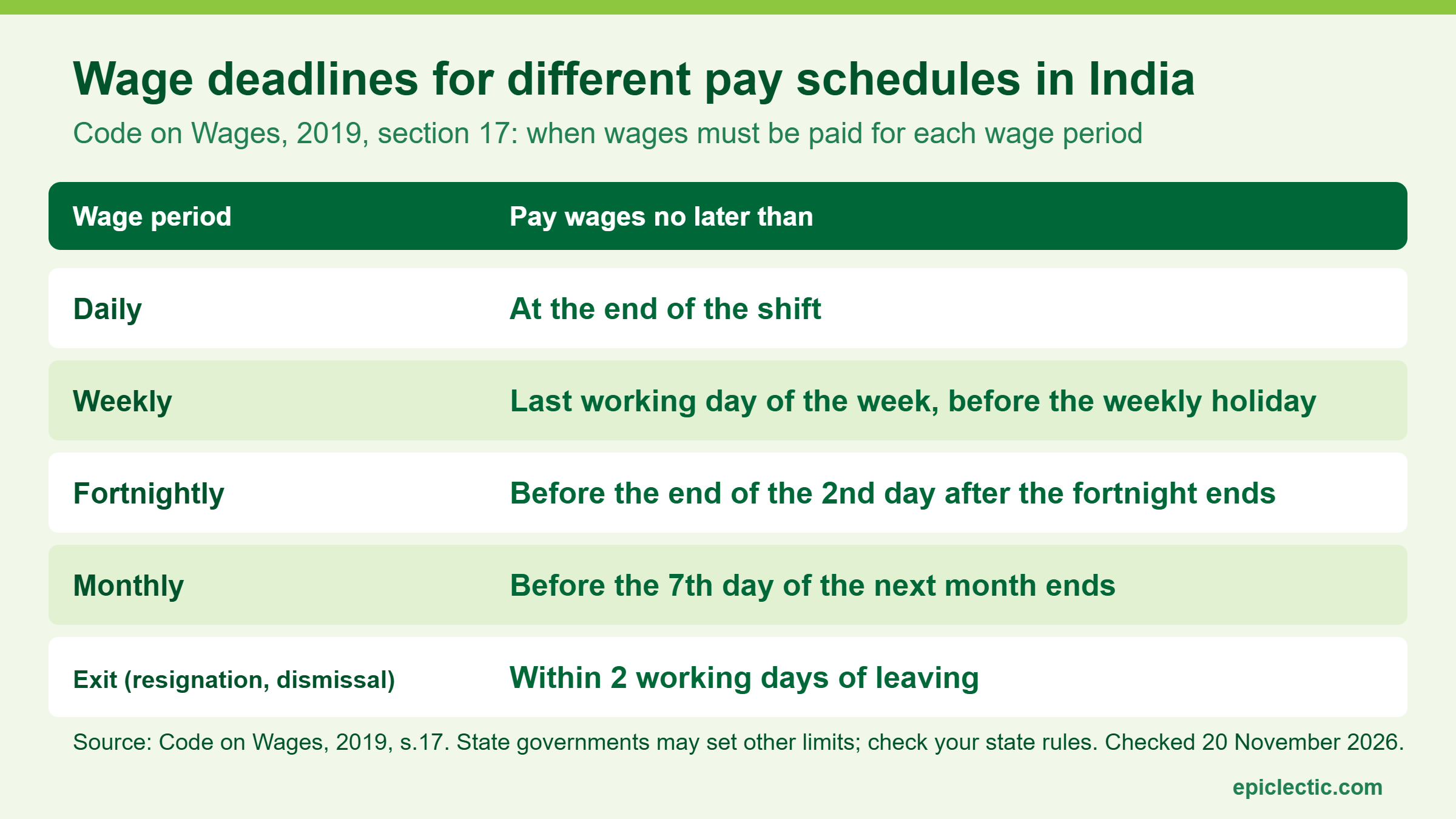
Wage deadlines for different pay schedules in India
A good calendar should include more than the payment date. It should also show when attendance records must be ready and when salary amounts must be checked. For example, if workers are paid every Saturday, their attendance records may need to be ready by Wednesday evening, which gives the payroll team time to check mistakes before payday.
4. Keep employee records in one place
Different pay schedules can create confusion when employee information is spread across many files. One employee’s details may be saved in an Excel sheet, another’s leave may be written in a notebook, and attendance may sit in a separate file. When salary day comes, someone must collect it all, and that takes time.
A better method is to keep each employee’s important details in one place. These records should include:
- employee name and ID;
- job role and department;
- payment schedule and agreed salary or wage rate;
- working days or hours and attendance details;
- approved leave and salary advances;
- UAN (PF), ESI number, PAN and bank details;
- payment history.
For example, if an employee receives weekly wages, the record should clearly show that schedule, so the owner does not need to remember it. When records are clear, it is easier to prepare the right payment for the right person.
5. Set a clear cut-off date for attendance
Attendance plays an important role in salary calculations, especially for employees paid by the number of days or hours they work. Suppose a small shop has six part-time employees on weekly wages, with a pay period from Monday to Sunday. If attendance records are still being changed on payday, the owner may struggle to calculate the correct amount.
A simple solution is a cut-off date: the final date for collecting and checking work records for a pay period. If workers are paid on Saturday, the business may close its records on Tuesday or Wednesday and use the remaining days to check attendance and prepare payments. Employees should know when their records close, and managers should fix missing entries before the cut-off. This reduces last-minute confusion and helps payments go out on time.
6. Check working hours before calculating wages
Not all employees receive a fixed salary. Some are paid by the hour and others by the number of days they work, so accurate attendance records matter.
Illustrative example
A part-time worker earns ₹100 an hour and works 30 hours in a pay period: 30 × ₹100 = ₹3,000. If the attendance record shows only 27 hours, the payment becomes ₹2,700, a difference of ₹300, and the employee may raise a complaint after payday.
To avoid this, managers should check working hours before the pay period closes and correct any missing entry through the business’s normal approval process. Overtime must be checked separately: under section 14 of the Code on Wages, overtime is paid at not less than twice the normal rate of wages.
7. Manage leave without mixing up payment periods
Leave can make different pay schedules harder to manage. A monthly employee may take two days off in a month, while a weekly worker may take one day off in a seven-day period. The effect on pay depends on the employee’s leave balance, terms and company policy.
Imagine a worker takes an approved day of paid leave. If the business forgets the approval, it may cut the worker’s pay by mistake, and the worker has to ask for a correction. A simple leave record prevents this. It should show the leave date, leave type, approval status, whether the leave is paid, and which payment period it belongs to. Checking leave before salary calculation avoids corrections later.
8. Handle salary advances carefully
Sometimes employees ask for part of their wages before payday because of an emergency or an urgent family expense. Giving an advance may seem simple, but problems start when it is not recorded properly.
Illustrative example
An employee receives a ₹2,000 advance. At the end of the pay period, their wages before adjustment are ₹8,000. If the agreed advance is recovered from this payment, the amount paid is ₹6,000. Forget the advance and the business overpays; record it twice and it underpays.
Every advance should have a clear written record, and the employee should know how and when it will be adjusted. Deductions must be ones the Code on Wages permits and must stay within its limits. This matters even more when weekly, fortnightly and monthly employees work in the same business.
9. Keep enough money ready for each payment date
A business may earn money every day, but salaries are paid on specific dates. With different pay schedules, wages can fall due several times a month. For example, a business may need to pay:
- ₹20,000 for weekly workers every Saturday;
- ₹35,000 for fortnightly workers twice a month;
- ₹1,20,000 for monthly employees at month-end.
Statutory payments add to this. TDS on salary (section 392 of the Income-tax Act, 2025, which replaced section 192 from 1 April 2026) is deposited by the 7th of the next month. EPF (12% employee and 12% employer) and ESI (0.75% employee and 3.25% employer, for wages up to ₹21,000 a month) are due by the 15th, covering every pay run in the month.
An owner who only plans for month-end salaries may forget weekly payments and run short of cash. At the start of each month, list every expected payroll and statutory payment with its date, and include any extra fortnightly payday in that month.
10. Give one person responsibility for each payment run
In small businesses, several people handle different parts of payroll. A supervisor records attendance, an office assistant prepares salary details and the owner approves the final amount. This works when everyone knows their role. Problems begin when the supervisor thinks the assistant has checked attendance and the assistant thinks the supervisor has, and the mistake is only found on payday.
Assign one person to collect attendance, another to check payment amounts if needed, and an authorised person to approve payments. In a very small business one employee may do several tasks, but the order of work should still be clear. Keep a record of who prepared and approved each payment, so errors are easier to trace.
11. Use a simple payroll checklist for different pay schedules
Different pay schedules need regular checks, and a short checklist helps the person managing payroll remember the important tasks.
Before each payment date, check that:
- the correct employees are in the payment group;
- the payment period dates and legal deadline are correct;
- attendance and working hours have been checked;
- approved leave has been recorded;
- overtime and additional payments have been reviewed;
- salary advances and permitted deductions have been checked;
- PF, ESI and TDS have been calculated;
- final amounts are approved and bank details are correct.
The checklist does not need to be complicated. The same business might use it every Thursday for weekly workers and again at month-end for permanent staff, so the team follows the same steps without mixing up groups.
12. Avoid mixing weekly and monthly salary records
A common problem is putting all employees on one salary sheet without showing their payment schedules. Suppose a business has 15 employees: five on weekly wages and ten on monthly salaries. With one large sheet, it is easy to include the wrong person in a payment run, pay someone twice or miss someone.
Group employees by payment schedule instead, with a clear weekly record for weekly workers and a separate monthly record for monthly staff. The business can still keep all information in one main system; the key is to identify which employees belong to each pay period and check the list before paying.
13. Send clear payment details to employees
Employees want to know when they will be paid and how their pay was worked out. The Code on Wages requires employers to issue a wage slip, physical or electronic, on or before the day wages are paid. It should show the employee’s name, pay period, earnings, deductions and final amount. For hourly workers, show the hours used; for monthly employees, show the monthly salary and any approved adjustments.
The wage slip should match the employee’s actual schedule: a weekly worker should not receive a slip that appears to cover a full month. Clear records help employees understand their wages and make it easier to answer questions.
14. Use payroll software to manage different payment dates
As a business grows, handling different pay schedules with notebooks and separate spreadsheets takes more time. Five employees may be manageable by hand, but 30 or 50 mean many more attendance entries, leave requests and salary changes to check.
This is where payroll software helps. TAZK Payroll & HRMS offers attendance management, leave management, payroll processing and employee records, so attendance can be checked against employee details instead of collecting information from unrelated files. A business should still confirm that its chosen plan supports the exact wage periods and pay rules it needs, including PF, ESI and TDS. Software reduces repetitive work, but correct information, clear approvals and regular checks are still essential.
15. Review payment errors after every payroll run
Even with a clear plan, mistakes happen. An employee forgets to record attendance, leave is approved late, or an advance is entered under the wrong pay period. Keep a simple error record: what happened, which payment period was affected, how it was corrected and what will prevent it next time.
If a weekly worker’s attendance is often missing, the manager may need to check it more regularly. If monthly salaries are repeatedly delayed because approvals come late, set an earlier approval deadline. Over time, these small changes stop the same mistake happening again.
16. Make sure different pay schedules follow the rules
A payment schedule should work for both the business and its employees, but dates cannot be chosen without considering employment law. For a business operating in India, the key points are:
- Wage deadlines (Code on Wages, section 17): weekly wages before the weekly holiday, fortnightly wages within two days of the fortnight ending, monthly wages by the 7th of the next month, and full and final settlement within two working days of an employee leaving.
- All employees covered: since the labour codes took effect on 21 November 2025, the timely payment and deduction rules apply to every employee, not only lower-paid workers.
- Wages definition: basic pay, dearness allowance and retaining allowance should make up at least 50% of total pay, or excess allowances are added back for PF and other benefits.
- State rules: minimum wages, professional tax and some deadlines vary by state.
Explain the payment schedule when an employee joins. If the schedule changes, give affected employees clear written notice before the change. When in doubt, take advice from a qualified payroll or labour-law professional.
17. Prepare for holidays and unexpected delays
Sometimes a payday falls on a bank holiday or another non-working day, which causes problems if the business only starts preparing that day. For example, a weekly payment may fall on a day when banks are closed. Plan ahead and pay early so the legal deadline and the employee’s terms are still met.
Mark known national and state holidays on the payment calendar, and leave enough time for checking and approval. If the person responsible for payroll is absent, another authorised employee should know how to complete the work, so salaries never depend on one person’s availability.
18. Review pay schedules as the business grows
A process that works for five employees may not work for fifty. Growth can bring more part-time workers, a new branch or extra shifts. A retail shop that opens a second location might pay the new branch’s staff weekly while the original shop continues monthly, so attendance and salary data now come from two places.
Review the payroll process whenever the team grows or working patterns change. Check that employee groups are clearly identified, payment dates are realistic and managers can provide records on time, and ask employees whether their payment information is clear.
19. A simple example of managing three different pay schedules
Illustrative example
A small retail business has 20 employees in three groups: ten full-time employees on monthly salaries, six part-time employees on weekly wages, and four delivery workers paid fortnightly.
- Every week, the supervisor checks the part-time workers’ attendance before their Saturday payment.
- At the end of each fortnight, the office team checks the delivery workers’ records and pays them within two days.
- Before month-end, the manager checks attendance, leave and other salary details for full-time employees, who are paid by the 7th.
- Each payment goes through a final review, and the owner keeps a calendar of the money needed for each payment date, including PF, ESI and TDS.
The process does not need to be difficult. It needs clear records, fixed responsibilities and regular checks.
FAQs
Can a small business in India pay employees on different pay schedules?
Yes. The Code on Wages lets the employer fix a daily, weekly, fortnightly or monthly wage period for each worker, so different groups can be paid on different schedules, each within its own legal deadline.
What is the latest date to pay monthly salaries?
Before the end of the 7th day of the following month. November salaries, for example, must be paid by 7 December, unless your state has set a different limit.
Is paying twice a month allowed?
“Twice a month” on fixed dates is not one of the wage periods the Code names. If you want two paydays a month, use a fortnightly wage period.
Do weekly-paid workers need PF and ESI deductions?
Yes, if they are covered. Deduct contributions in each weekly pay run and deposit the month’s total by the 15th of the following month.
How can software help with different pay schedules?
Payroll software keeps attendance, leave and salary data in one place and can run a separate pay calendar for each group, which reduces manual work and missed payments.
Conclusion
Managing payroll becomes harder when employees receive their wages on different dates. Weekly workers, part-time staff and monthly employees all need accurate payment records, and when their information is mixed together the business may face delays, wrong amounts and repeated corrections.
Small businesses can avoid most of these problems by creating separate payment calendars, keeping employee records organised, checking attendance before each cut-off and reviewing payments before sending them. A simple checklist helps the payroll team follow the same steps every time, and as the team grows, tools such as TAZK Payroll & HRMS can bring attendance, leave and payroll information together. The goal is simple: every employee should know when they will be paid, and the business should have the right information ready before that date.
Official sources: Ministry of Labour and Employment (Code on Wages, 2019) · PIB factsheet on the labour codes · Income-tax Department · EPFO · ESIC. Checked 20 November 2026.
We review this guide every 12 months, or sooner if rules change. Last reviewed: November 2026.