
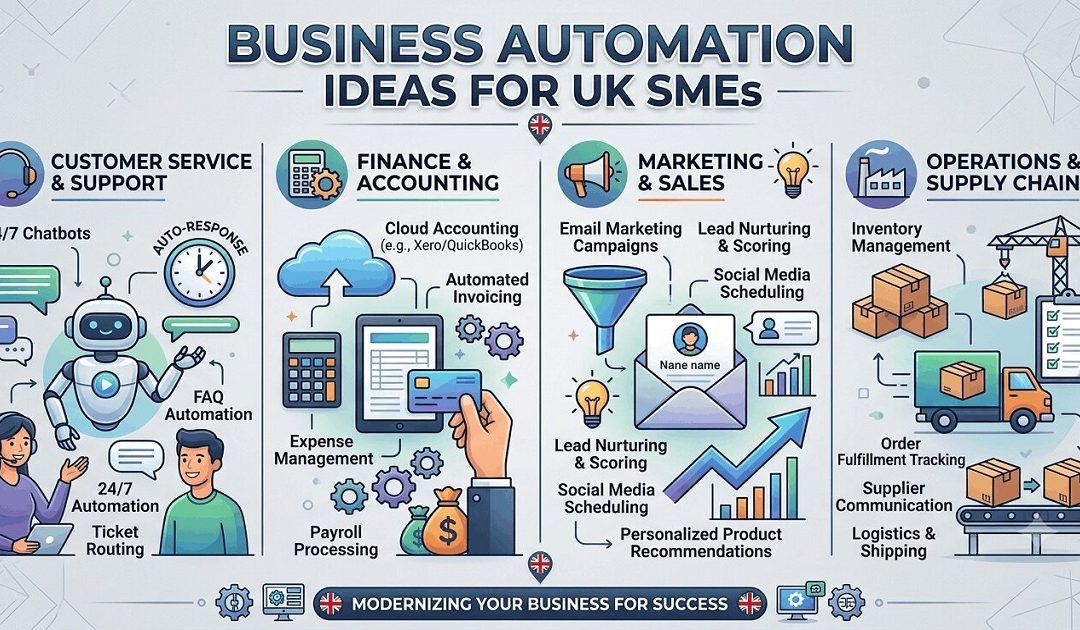
Automation is transforming how UK businesses operate, saving time and driving efficiency. From small startups to established SMEs, digital tools can streamline everyday office tasks. Discover practical business automation ideas tailored for UK companies, including affordable solutions. Unlock the benefits of automation and future-proof your business with easy, actionable strategies. This guide from Epiclectic covers business automation ideas in plain English, with steps you can use right away. Whether you’re a beginner or already know the basics, you’ll find useful advice below. We’ll walk through exactly what to consider and how to get it right. By the end, you’ll know precisely what to do next.
Business automation ideas for UK SMEs include automating repetitive office tasks, using workflow automation tools, and adopting digital solutions to improve efficiency and reduce errors.
Key Takeaways
- Business automation can save UK SMEs hundreds of hours per year.
- Affordable automation solutions are available for even the smallest firms.
- Workflow automation boosts accuracy and frees staff for higher-value work.
- Digital transformation is not just for big corporations—SMEs can benefit too.
- Choosing the right automation tools depends on your business size and goals.
Why Trust This Guide?
Epiclectic delivers practical, fact-checked automation advice tailored to UK SMEs:
- Editorially reviewed for accuracy
- Original and plagiarism-free
- Written for real readers, not search engines
- Regularly reviewed and updated
- Last reviewed: July 2026.
Business Automation Ideas for UK SMEs
This article explores the most effective business automation ideas for UK companies, including practical examples, tool comparisons, and step-by-step guidance for small businesses.
Business Automation Ideas: What UK SMEs Need to Know
59% of UK SMEs have adopted at least one automation tool by 2025 (source: Tech Nation, 2025). This figure highlights a dramatic shift in how small and medium-sized enterprises approach everyday business operations. Automation is no longer the preserve of large corporations; it is a practical, accessible strategy for driving process efficiency and reducing costly errors in businesses of all sizes. For UK companies, business automation ideas are not just about technology—they are about making your business more resilient and adaptable in a changing market.
One of the most persistent misconceptions is that automation is too expensive or technically complex for smaller firms. In reality, many affordable automation solutions UK SMEs can use are designed with simplicity and cost-effectiveness in mind. For example, digital workflow solutions that automate office tasks such as appointment scheduling, invoice chasing, or document management are now within reach for businesses with just a handful of staff.
Adopting automation delivers measurable benefits: cost savings, improved staff efficiency, and better customer satisfaction. According to Enterprise Nation, UK SMEs using workflow automation report a 20% average increase in productivity by 2026. This means more time for your team to focus on strategic work, fewer mistakes, and a stronger competitive position. If you’re looking for actionable business automation ideas, start by targeting repetitive, high-volume tasks and selecting tools that fit your size and sector. For more on business operations and digitalisation, visit Epiclectic’s Business section. You can also find further guidance on GOV.UK.
Stat: 59% of UK SMEs have adopted at least one automation tool by 2025 (source: Tech Nation, 2025).
What is business automation?
Business automation is the use of software or digital tools to perform repetitive business processes with minimal human intervention, increasing efficiency and accuracy.
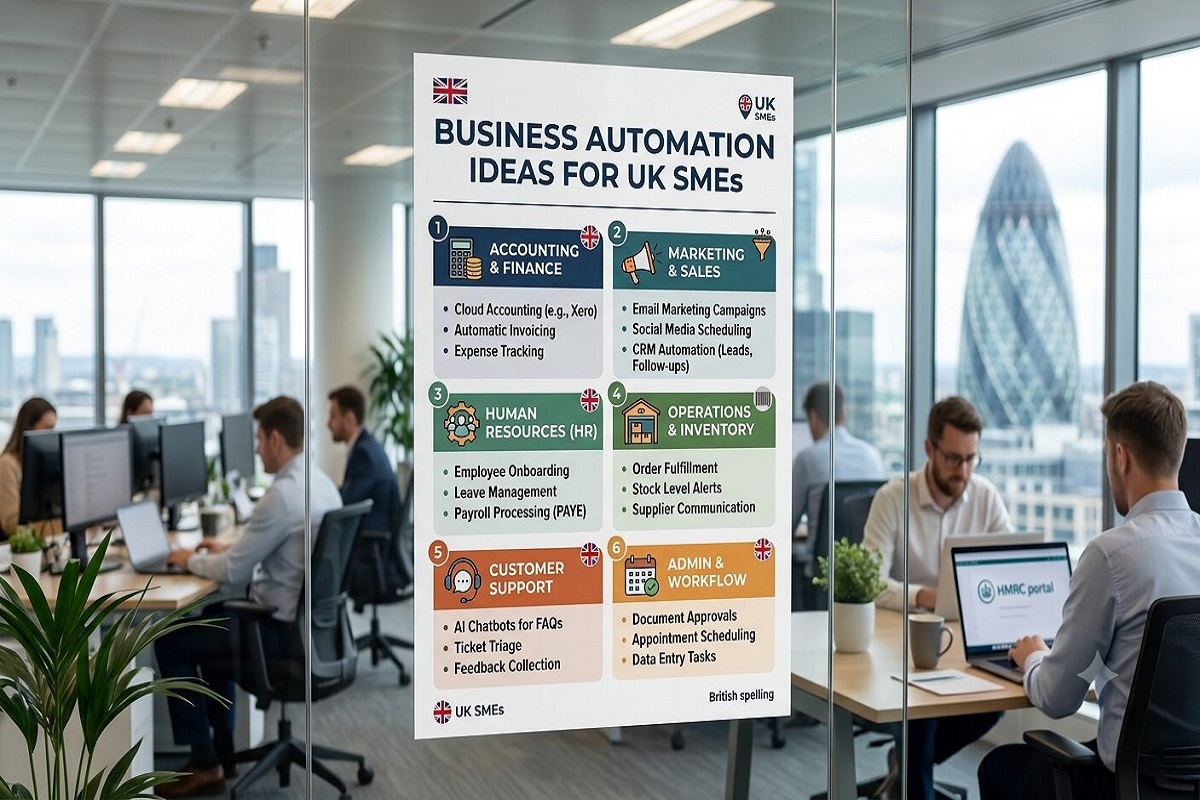
How Do UK Businesses Automate? Real-World Examples
UK SMEs are leading the way in practical automation. Here’s how real businesses are putting business process automation examples UK into action:
- Automated invoicing reduces late payments and admin time
- Customer follow-up emails are triggered automatically after sales or appointments
- Social media scheduling tools post content at optimal times without manual input
- Appointment booking systems sync with calendars and send reminders to clients
- Email marketing tools segment contacts and send targeted campaigns
- HR onboarding processes are managed through digital checklists and e-signatures
One Leicester-based SME automated its appointment scheduling and invoice follow-ups. Previously, staff spent hours sending reminders and managing bookings, leading to missed appointments and delayed payments. By implementing an automated workflow, the business halved its admin time and saw a 30% reduction in missed appointments—a direct boost to both customer satisfaction and cash flow.
To help you visualise how UK businesses automate, the table below summarises real automation scenarios, their impact, and the lessons learned:
| Scenario | Before Automation | After Automation | Key Outcome |
|---|---|---|---|
| Appointment Scheduling | Manual reminders, frequent no-shows | Automated reminders, online booking | 30% fewer missed appointments |
| Invoice Chasing | Staff manually emailed overdue clients | Automated invoice follow-ups | Late payments cut by 40% (source: Xero, 2026) |
| Social Media Posting | Staff posted manually, inconsistent timing | Scheduled posts via automation tool | Consistent brand presence, less staff time |
| HR Onboarding | Piles of paperwork, slow onboarding | Digital onboarding workflow | Faster start for new hires, fewer errors |
These business process automation examples UK show that even small changes can have an outsized impact. The key is to start with one process, measure the results, and expand gradually. For more on automation in business finance, see Epiclectic’s Accounting section. Additional case studies are available at Smarta.
Quick Tip: Start with one simple process—such as invoice reminders—before automating more complex workflows.
Stat: Automated invoicing reduces late payments by up to 40% for UK small businesses (source: Xero, 2026).
What Tasks Should You Automate First? A Decision Guide
Which office tasks should you automate first? The answer depends on how repetitive, time-consuming, and error-prone each process is. For most UK SMEs, high-frequency tasks like data entry, appointment scheduling, and invoice management are the best starting points.
Use the decision tree below to decide whether a task is a good candidate for automation:
| Question | Recommended Action |
|---|---|
| Is the task repetitive and rules-based? | Automate using workflow tools |
| Does the task require human judgement? | Keep manual or semi-automate |
| Is the process business-critical? | Consult a professional for automation |
Before automating, prepare by mapping your current process, setting clear goals, and ensuring data quality. For example, if you want to automate appointment scheduling, make sure your calendar system is up to date and that staff know how to use the new tool. Most guides skip this step, but mapping out the existing workflow prevents costly errors later on.
Quick Tip: Test automation on a small scale first—such as a single department or process—before rolling out across your business.
What is workflow automation?
Workflow automation is the use of digital tools to manage, track, and trigger business processes automatically, reducing manual oversight and increasing consistency.
Stat: UK SMEs using workflow automation report a 20% average increase in productivity (source: Enterprise Nation, 2026).
Affordable Automation Solutions UK SMEs Can Actually Use
Imagine a small business owner in Nottingham looking for affordable automation solutions UK SMEs can use. They want to automate invoicing, manage HR paperwork, and send marketing emails, but worry about costs and complexity. The good news is that simple automation for small business UK is now easier and more cost-effective than ever.
- Cloud-based tools offer invoicing, payroll, and HR features for as little as £10–£20 per month.
- Many office automation tools provide free trials or entry-level plans for SMEs.
- Integration with existing software—such as email or calendars—reduces setup time and training needs.
- When choosing a tool, prioritise UK-based support and transparent pricing to avoid unexpected fees.
- Be wary of “free” tools that charge high fees after a trial period or lack essential features for UK compliance.
- Look for automation solutions with strong user communities and online resources for troubleshooting.
Affordable automation solutions UK SMEs can use range from simple email automation to sophisticated workflow management platforms. For detailed reviews, see Which? and Epiclectic’s Business section.
Quick Tip: Always check if an automation tool offers UK support and integrates with your existing systems before committing.
What is automation software?
Automation software is a digital platform that performs business processes and tasks automatically, often integrating with other systems to streamline operations.
Best Business Automation Tools UK: A Comparison Table
UK SMEs spend an average of £35 per month on automation tools, with 82% rating ease of use as their top priority (source: TechRadar, 2026). The best business automation tools UK companies rely on combine robust features, UK-based support, and clear pricing. Choosing the right platform depends on your business needs—finance, marketing, HR, or project management.
Below is a comparison table of popular business automation tools for UK SMEs, including features, support, and typical costs:
| Tool Name | Key Features | UK Support | Approximate Monthly Cost | Best For |
|---|---|---|---|---|
| Zapier | Workflow automation, integrations | Yes | £20–£65 | General office tasks |
| Xero | Invoicing, accounting automation | Yes | £15–£50 | Finance/Accounting |
| Trello | Project management automation | Yes | Free–£17 | Task management |
| Mailchimp | Email marketing automation | Yes | Free–£50 | Marketing |
| Slack | Automated notifications, bots | Yes | Free–£10 | Team communication |
Each tool has unique strengths. For example, Xero is ideal for automating invoicing and financial reporting, while Trello excels at automating project workflows. Zapier connects different software, allowing you to automate tasks across multiple platforms without coding. Mailchimp is a popular choice for small businesses looking to automate email campaigns, and Slack is widely used for team communication and automated alerts. Always check for UK-specific features and support, especially for compliance and data protection. For more in-depth reviews, visit TechRadar.
- Zapier: Best for integrating multiple apps and automating cross-platform workflows.
- Xero: Best for financial automation and reporting in UK SMEs.
- Trello: Best for task and project management automation.
- Mailchimp: Best for marketing automation and customer engagement.
- Slack: Best for internal communication and automated notifications.
Quick Tip: Use free trials to test multiple tools before deciding which best fits your SME’s needs.
Digital Transformation for SMEs UK: Trends, Pitfalls, and Future Opportunities
Digital transformation is now a necessity for SME competitiveness in the UK. It goes beyond simply digitising paperwork; it involves rethinking how your business operates, serves customers, and adapts to new technologies. The latest automation trends in the UK include artificial intelligence for customer service, cloud-based workflow management, and seamless integration between systems. According to Enterprise Nation, 74% of UK SMEs plan to increase spending on digital transformation in 2026.
However, many businesses underestimate the importance of staff training and change management. Most guides focus on technology, but the real challenge is ensuring your team understands and embraces new tools. Over-reliance on technology without adequate human oversight can also introduce new risks, such as data security vulnerabilities or process breakdowns if a tool fails.
Looking ahead, the most successful UK SMEs will be those that blend automation software with ongoing staff development. For example, pairing AI-driven chatbots with well-trained customer service staff creates a seamless experience for clients. Cloud-based platforms that integrate finance, HR, and marketing functions are becoming the norm, allowing SMEs to respond quickly to market changes. For more on digital transformation for SMEs UK, visit Enterprise Nation and Epiclectic’s Business section.
Stat: 74% of UK SMEs plan to increase spending on digital transformation in 2026 (source: Enterprise Nation, 2026).
What is SME digital transformation?
SME digital transformation is the process by which small and medium-sized enterprises adopt digital technologies to improve business operations, customer experience, and competitiveness.
Workflow Automation for UK Companies: Step-by-Step Guide
How can you implement workflow automation for UK companies? The key is to follow a structured process, from initial planning to measuring success. Start by mapping out your existing business processes. Identify which steps are repetitive, time-consuming, or prone to mistakes. Involve your staff early to ensure buy-in and identify potential obstacles.
- Map your current workflow and document each step.
- Prioritise tasks that are repetitive and rules-based for automation.
- Choose workflow automation tools that integrate with your existing systems.
- Test the automation on a small scale and gather feedback from staff.
- Measure the impact using metrics such as time saved, error rates, and staff satisfaction.
The following table shows a step-by-step workflow automation example for a typical UK SME:
| Step | Action | Outcome |
|---|---|---|
| 1. Identify Process | Choose invoicing as target process | Clear focus for automation |
| 2. Map Workflow | Document each step in invoicing | Understand current bottlenecks |
| 3. Select Tool | Pick an invoicing automation tool | Ready to automate |
| 4. Test & Train | Run pilot, train staff | Ensure smooth adoption |
| 5. Measure Results | Track time saved, payment speed | Assess ROI, plan next steps |
By following these steps, you can ensure your workflow automation delivers real value and avoids common pitfalls. For more on workflow management and digital solutions, see Epiclectic’s Business section or the Chartered Institute of Marketing blog.
Quick Tip: Always involve end-users in the planning phase—they often spot issues that managers overlook.
Automating Small Businesses UK: Overcoming Challenges and Getting Started
Imagine a small business in Manchester with five employees. They want to start automating small businesses UK but worry about budget, staff resistance, and technical skills. The most common barriers are fear of change, limited resources, and uncertainty about where to begin. Yet, the most successful SMEs address these challenges head-on by involving staff in the decision-making process and choosing automation tools with strong UK support.
To get buy-in from your team, communicate the specific benefits—such as reducing admin workload or improving customer response times. Offer training sessions and encourage feedback throughout the rollout. A clear action plan is essential for your first automation project:
- Map the process you want to automate (e.g., appointment booking)
- Research tools that fit your budget and integrate with your current systems
- Test the tool with a small group and gather feedback
- Train all relevant staff and set clear goals
- Monitor results and adjust as needed
By following these steps, even the smallest UK businesses can benefit from automation without major disruption. For more on automating small businesses UK, visit Epiclectic’s Business section or the Federation of Small Businesses.
Quick Tip: Start with a low-risk, high-impact process to build confidence and show value.
Business Automation Ideas in Leicester, London, Birmingham, Manchester, Nottingham, and the East Midlands
Business automation ideas near me are increasingly relevant as more companies across the UK seek local solutions. In Leicester, SMEs are adopting digital workflow solutions for appointment scheduling and customer management, with strong support from local tech hubs. Business automation ideas in London often focus on integrating cloud-based tools for finance and marketing, reflecting the city’s diverse business landscape.
In Birmingham, affordable automation solutions UK SMEs can use are helping manufacturers and service firms digitise HR and payroll processes. Manchester is a hotspot for workflow automation for UK companies, especially in creative and digital sectors. Nottingham businesses are turning to office automation tools for document management and compliance, while East Midlands SMEs benefit from regional grants supporting digital transformation for SMEs UK.
Wherever you’re based, local business automation ideas UK should focus on tools that offer strong UK support, compliance features, and integration with existing systems. For more region-specific advice, explore Epiclectic’s Business guides or consult local enterprise networks.
Automation in UK SMEs: Key Statistics
Stat: 59% of UK SMEs have adopted at least one automation tool by 2025 (Source: Tech Nation, 2025).
Stat: Automated invoicing reduces late payments by up to 40% for UK small businesses (Source: Xero, 2026).
Stat: UK SMEs using workflow automation report a 20% average increase in productivity (Source: Enterprise Nation, 2026).
Common Mistakes to Avoid
- Automating without mapping current processes: Skipping this step leads to inefficient automations and missed opportunities.
- Choosing tools with limited UK support: Lack of local support can cause delays and additional costs.
- Ignoring staff training: Without proper training, automation adoption fails and errors increase.
Frequently Asked Questions
What are the main benefits of automation in business for UK SMEs?
Automation reduces manual effort, lowers costs, improves accuracy, and frees staff to focus on growth in UK SMEs.
Which business processes are easiest to automate?
Common easy wins include invoicing, data entry, customer follow-ups, and scheduling—especially with ready-made UK tools.
How do I choose the best automation tool for my small business?
Assess your most time-consuming tasks, compare tool features and costs, and choose one with strong UK support and integration.
Is automation only suitable for tech-savvy businesses?
No, modern automation tools are designed for ease of use and require minimal technical skills to implement.
Can automation help with compliance and reporting?
Yes, automation can simplify compliance tasks, track deadlines, and generate real-time reports for UK regulations.
What are the risks of automating business processes?
Risks include data security, over-reliance on technology, and inadequate staff training—mitigated by proper planning and support.
Editorial Insight
According to Epiclectic’s editorial team: “UK SMEs stand to gain significant productivity and competitive advantages by adopting business automation, but success depends on choosing the right tools and ensuring staff buy-in.”