
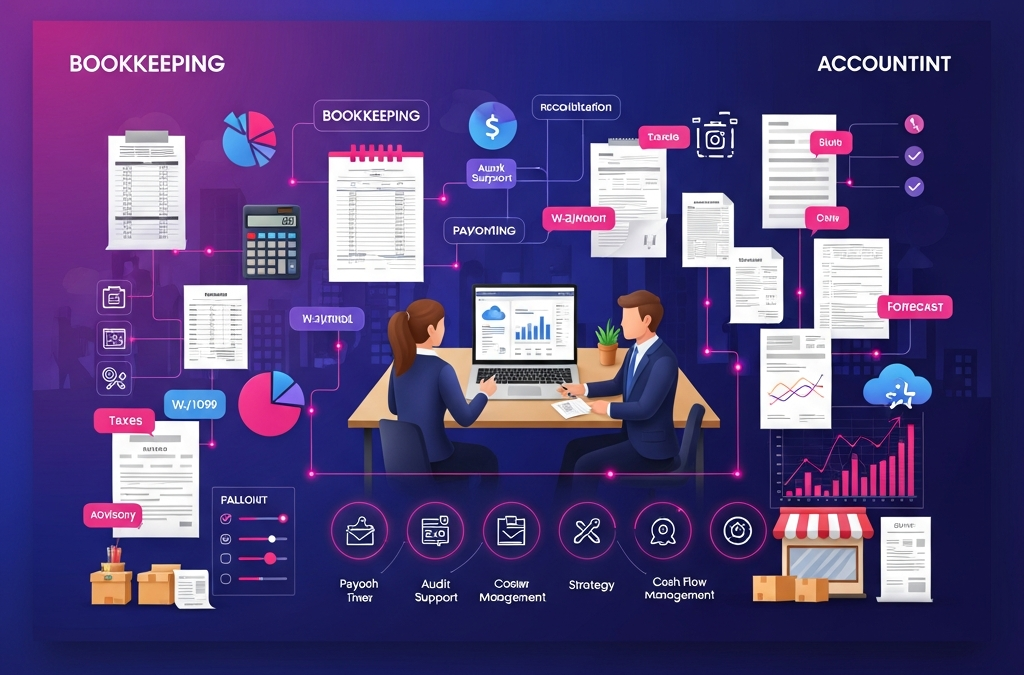
Key Takeaways
- Accountants offer a comprehensive spectrum of services, ranging from foundational bookkeeping to advanced strategic financial advisory.
- Core services include meticulous tax planning and compliance, efficient payroll management, and accurate financial reporting.
- Beyond compliance, accountants provide critical insights through financial analysis, budgeting, forecasting, and business growth strategies.
- Leveraging professional accounting expertise helps small businesses mitigate risks, ensure regulatory adherence, save time, and make informed decisions that drive profitability and sustainable growth.
- Choosing the right accountant, whether local or virtual, with relevant industry experience and technological proficiency, is a strategic investment for any small business.
Introduction
Small businesses are vibrant engines of our economy, yet their journey is often fraught with complex financial challenges. From managing daily transactions to navigating intricate tax codes, entrepreneurs can quickly become overwhelmed by the sheer volume of financial responsibilities. This is where the invaluable expertise of professional accountants comes into play. This article delves into what services do accountants provide to small businesses, detailing how their specialized knowledge can be a cornerstone for efficiency, ensure unwavering compliance, and ultimately fuel sustainable growth. By offloading financial complexities to experts, business owners can reclaim precious time and focus on their core operations, confident that their financial health is in capable hands.
The Comprehensive Spectrum of Accounting Services for Small Businesses
Foundation: Core Bookkeeping and Financial Reporting
Daily Transaction Recording
- Systematic Data Entry: Meticulously entering all income and expenses into an accounting system.
- Categorization: Accurately classifying transactions (e.g., sales revenue, marketing expenses, utility costs) to ensure proper financial statement presentation.
- General Ledger Maintenance: Keeping the central repository of all financial transactions organized and up-to-date.
- Software Utilization: Proficient use of popular accounting software solutions like QuickBooks Online, Xero, or Sage for streamlined processing.
Bank Reconciliation
- Matching Records: Comparing the company’s internal cash records with the bank statements.
- Identifying Discrepancies: Pinpointing outstanding checks, deposits in transit, bank errors, or unrecorded transactions.
- Ensuring Accuracy: Verifying the correctness of cash balances, which is crucial for fraud detection and financial integrity.
Generating Financial Statements
- Profit & Loss Statement (Income Statement): Detailing revenues, costs of goods sold (COGS), operating expenses, and ultimately, net profit or loss over a period. Essential for understanding profitability.
- Balance Sheet: Providing a snapshot of the business’s financial position at a specific point in time, outlining assets, liabilities, and owner’s equity.
- Cash Flow Statement: Tracking the movement of cash into and out of the business from operating, investing, and financing activities. Crucial for liquidity management.
- Decision-Making Tool: These statements are vital for internal strategic decisions, securing loans, or attracting investors.
Strategic Tax Planning and Compliance
Taxation is one of the most complex and critical areas for small businesses. Accountants ensure compliance while strategically minimizing tax liabilities.
Business Tax Preparation
- Annual Tax Return Filing: Preparing and submitting federal, state, and local income tax returns (e.g., Form 1120 for C-Corps, 1120-S for S-Corps, 1065 for Partnerships, Schedule C for Sole Proprietors).
- Compliance Assurance: Ensuring strict adherence to ever-evolving tax laws and regulations to avoid penalties.
- Deduction and Credit Identification: Proactively finding eligible deductions, credits, and allowances to reduce taxable income legally.
Sales Tax Management
- Permit Registration: Assisting with the registration for necessary sales tax permits in relevant jurisdictions.
- Collection and Remittance: Guidance on calculating, collecting, and accurately remitting sales tax to the appropriate authorities.
- Nexus Rules: Advising on sales tax nexus requirements, especially critical for businesses operating across multiple states or online.
Payroll Tax Compliance
- Withholding Calculations: Accurately calculating and withholding federal, state, and local income taxes, as well as Social Security and Medicare (FICA).
- Employer Contributions: Managing the employer’s share of FICA and unemployment taxes (FUTA, SUTA).
- Timely Filings: Ensuring timely deposit of payroll taxes and submission of required forms like 941, 940, and various state-specific reports.
Payroll Management Solutions
Managing payroll can be time-consuming and fraught with potential for error. Accountants offer comprehensive payroll services to ensure employees are paid accurately and on time, while adhering to all regulatory requirements.
- Gross and Net Pay Calculation: Determining gross wages, applying deductions, and calculating final net pay for employees.
- Payment Disbursement: Facilitating direct deposits or preparing physical checks.
- Record Keeping: Maintaining detailed payroll records, including hours worked, overtime, and leave balances.
- Leave Tracking: Managing sick leave, vacation time, and paid time off (PTO) accruals and usage.
Employee Benefits and Deductions
- Benefit Management: Administering deductions for health insurance premiums, retirement plan contributions (e.g., 401(k), SEP IRA).
- Compliance with Regulations: Ensuring adherence to regulations governing employee benefits, such as ERISA and the Affordable Care Act (ACA).
- Garnishments: Handling wage garnishments, child support payments, and other involuntary deductions according to legal mandates.
Year-End Reporting (W-2, 1099)
- W-2 Preparation: Generating and filing W-2 forms for all employees, reporting annual wages and taxes withheld.
- 1099 Preparation: Preparing and filing 1099 forms for independent contractors and vendors who meet specific payment thresholds.
- Worker Classification: Advising on proper classification of workers as employees vs. independent contractors to avoid significant penalties and legal issues.
Financial Analysis and Advisory Services
Beyond basic compliance, accountants transform raw financial data into actionable insights, helping small businesses make informed decisions and strategize for the future.
Budgeting and Forecasting
- Budget Development: Creating realistic and comprehensive annual or quarterly budgets that align with business goals.
- Future Projections: Forecasting future revenue, expenses, and cash flows to anticipate financial performance.
- Variance Analysis: Conducting regular comparisons of actual financial results against budgeted figures to identify deviations and understand their causes.
- Strategic Planning: Using budgets and forecasts as crucial tools for strategic planning and resource allocation.
Cash Flow Management
- Monitoring Inflows/Outflows: Closely tracking the movement of cash into and out of the business to prevent liquidity crises.
- Working Capital Optimization: Developing strategies to optimize working capital, improving cash conversion cycles.
- Early Warning System: Identifying potential cash flow shortages or surpluses proactively, allowing for timely adjustments.
- Liquidity and Solvency: Implementing measures to improve the business’s ability to meet short-term and long-term financial obligations.
Financial Performance Analysis
- Key Ratio Calculation: Calculating and interpreting crucial financial ratios (e.g., profitability, liquidity, solvency, efficiency ratios) to gauge business health.
- Trend Analysis: Analyzing financial data over multiple periods to identify patterns, strengths, and weaknesses.
- Industry Benchmarking: Comparing the business’s performance against industry averages and competitors to pinpoint areas for improvement or competitive advantage.
- Operational Insights: Translating financial numbers into practical recommendations for operational efficiency and increased profitability.
Business Advisory and Growth Strategy
Accountants are not just number crunchers; they can be trusted advisors, offering guidance on critical business decisions and long-term growth.
Business Planning and Setup
- Entity Selection: Advising on the most advantageous legal structure (Sole Proprietor, LLC, S-Corp, C-Corp) for tax, liability, and operational purposes.
- Registration Assistance: Guiding through business registration, permit applications, and necessary licenses.
- Comprehensive Business Plans: Assisting in developing detailed business plans that outline objectives, strategies, and financial projections for new ventures.
- Startup Consulting: Providing tailored advice and support to entrepreneurs launching new businesses.
Business Valuation
- Fair Market Value Estimation: Determining the accurate fair market value of a business, crucial for sales, acquisitions, mergers, or succession planning.
- Methodology Application: Employing various valuation methods, including asset-based, income-based, and market-based approaches.
- Strategic Applications: Providing valuations for internal strategic purposes, exit planning, or litigation support.
Growth and Expansion Strategies
- Financing Options: Advising on suitable financing avenues, including debt financing (loans), equity financing (investors), or government grants.
- Market Analysis: Assisting in the financial analysis of new market entry strategies or product/service expansion opportunities.
- Mergers & Acquisitions: Conducting financial due diligence for potential mergers, acquisitions, or divestitures.
- Risk Assessment: Evaluating the financial risks and rewards associated with significant strategic initiatives.
Technology Integration and Accounting Software
In the digital age, leveraging technology is crucial for efficient financial management. Accountants play a key role in implementing and optimizing these tools.
Software Selection and Implementation
- Needs Assessment: Evaluating the business’s specific requirements to recommend the most appropriate accounting software (e.g., QuickBooks, Xero, Sage, Zoho Books).
- Setup and Configuration: Assisting with the initial setup, customization, and migration of data to new accounting systems.
- Staff Training: Providing training and ongoing support to staff on how to effectively use the accounting software.
Cloud Accounting Solutions
- Benefits Explanation: Highlighting the advantages of cloud-based platforms, such as real-time data access, enhanced collaboration, and reduced infrastructure costs.
- Integration Services: Facilitating seamless integration of accounting software with other essential business tools like point-of-sale (POS) systems, customer relationship management (CRM) platforms, and inventory management systems.
- Remote Accessibility: Enabling business owners and their teams to access financial data securely from anywhere, at any time.
Data Security and Integrity
- Best Practices: Implementing robust protocols for protecting sensitive financial data from cyber threats and unauthorized access.
- Backup and Recovery: Establishing regular data backup procedures and comprehensive disaster recovery plans to ensure business continuity.
- Privacy Compliance: Ensuring compliance with data privacy regulations (e.g., GDPR, CCPA) relevant to financial information.
Audit Support and Compliance
While small businesses may not always require external audits, accountants provide crucial support in preparing for reviews and ensuring internal financial controls are robust.
Internal Controls Review
- Control Assessment: Evaluating existing internal financial controls to identify weaknesses and vulnerabilities to fraud or error.
- Process Improvement: Recommending and implementing improvements to financial processes for greater efficiency, accuracy, and security.
- Segregation of Duties: Advising on proper segregation of duties to prevent single points of failure and enhance accountability.
Preparation for External Audits
- Documentation Organization: Assisting in organizing and preparing all necessary financial records, documentation, and supporting evidence for auditors.
- Auditor Liaison: Acting as a primary point of contact and liaison between the business and external auditors, addressing queries and facilitating the audit process.
- Efficiency Streamlining: Helping to streamline the audit process, reducing disruptions to business operations and potential audit fees.
Regulatory Compliance Guidance
- Regulatory Updates: Keeping the business informed of the latest changes in financial regulations, reporting standards, and industry-specific compliance requirements.
- Adherence Assurance: Ensuring the business consistently adheres to all applicable federal, state, and local reporting obligations.
- Risk Management: Proactively identifying and mitigating compliance risks to avoid penalties and legal issues.
Specialist Services: Industry-Specific Expertise
Some businesses operate in highly regulated or niche sectors, requiring specialized accounting knowledge. Accountants with industry-specific expertise can provide invaluable tailored services.
Niche Industry Compliance
- Sector-Specific Regulations: Understanding and ensuring compliance with unique regulations pertinent to specific industries (e.g., healthcare, real estate, manufacturing, tech, non-profits, e-commerce).
- Specialized Tax Incentives: Identifying and leveraging industry-specific tax deductions, credits, or grants that general accountants might overlook.
- Unique Accounting Standards: Applying specific accounting standards relevant to particular sectors, such as revenue recognition for subscription-based services or inventory valuation for manufacturing.
Grant and Funding Applications
- Financial Documentation: Assisting in preparing detailed financial statements, projections, and reports required for grant applications or government funding programs.
- Loan Proposals: Helping to compile comprehensive financial packages for Small Business Administration (SBA) loans or other specialized business financing.
- Investor Readiness: Preparing financial forecasts and presentations to attract private equity, venture capital, or angel investors.
Succession Planning
- Ownership Transfer Strategies: Developing tailored plans for the smooth transfer of business ownership, whether to family members, employees, or external buyers.
- Tax Implications: Analyzing and advising on the complex tax implications of succession, aiming to minimize liabilities for both the seller and the buyer.
- Business Continuity: Ensuring that the business can continue to operate successfully and profitably through leadership transitions, preserving its value and legacy.
Debt Management and Loan Assistance
Effective debt management and strategic loan acquisition are vital for growth. Accountants can guide businesses through these processes to optimize their financial structure.
Loan Application Support
- Financial Statement Preparation: Compiling accurate and up-to-date financial statements and projections required by lenders.
- Business Loan Proposals: Assisting in crafting compelling business loan proposals that highlight the company’s financial health and repayment capacity.
- Optimal Loan Structures: Advising on the most favorable loan types, terms, and interest rates for the business’s specific needs.
Debt Restructuring Advice
- Debt Analysis: Evaluating existing debt obligations, interest rates, and repayment schedules to identify opportunities for improvement.
- Creditor Negotiation: Providing guidance and potentially facilitating negotiations with creditors to secure more favorable repayment terms or interest rates.
- Financial Health Improvement: Implementing strategies to improve the business’s debt-to-equity ratio and overall financial solvency.
Lender Relationship Management
- Liaison Services: Acting as an intermediary between the business and financial institutions, fostering strong, transparent relationships.
- Covenant Compliance: Ensuring ongoing compliance with loan covenants and reporting requirements to maintain good standing with lenders.
- Credibility Building: Helping the business build a reputation of financial reliability and transparency with its banking partners.
International Business Considerations
For small businesses venturing into global markets, international accounting complexities require specialized knowledge to ensure compliance and profitability.
Cross-Border Tax Implications
- Tax Treaties: Understanding and applying international tax treaties to minimize double taxation and optimize global tax liabilities.
- Foreign Tax Credits: Advising on the availability and utilization of foreign tax credits to offset taxes paid in other countries.
- Jurisdictional Compliance: Ensuring adherence to the specific tax laws and regulations of each country where the business operates, sells, or employs personnel.
Foreign Currency Transactions
- Currency Fluctuation Accounting: Accurately accounting for gains and losses arising from fluctuations in foreign exchange rates.
- Hedging Strategies: Recommending and implementing hedging strategies to mitigate foreign currency risk for international transactions.
- Financial Statement Translation: Guiding the translation of foreign subsidiary financial statements into the parent company’s reporting currency.
International Compliance
- IFRS Adherence: Ensuring compliance with International Financial Reporting Standards (IFRS) if applicable, alongside local GAAP.
- Export/Import Regulations: Providing guidance on financial reporting requirements related to international trade regulations.
- FATCA and FBAR: Assisting U.S. businesses with foreign accounts or operations in complying with FATCA (Foreign Account Tax Compliance Act) and FBAR (Report of Foreign Bank and Financial Accounts) reporting.
Choosing the Right Accountant for Your Small Business
Selecting the right accounting partner is a critical decision that can significantly impact a small business’s success and financial stability.
Assessing Your Needs
- Service Requirements: Clearly identifying the specific accounting and financial services your business needs (e.g., basic bookkeeping, comprehensive tax planning, strategic advisory).
- Industry Expertise: Considering whether the accountant has experience with businesses in your specific industry, understanding its unique challenges and opportunities.
- Budget and Engagement Model: Determining your budget and preferred engagement model, whether hourly billing, fixed fees for specific services, or a retainer for ongoing support.
Key Qualities to Look For
- Qualifications: Verifying credentials such as Certified Public Accountant (CPA), Enrolled Agent (EA), or other relevant certifications.
- Experience: Prioritizing accountants with a proven track record of working successfully with small businesses of a similar size and complexity to yours.
- Communication Style: Seeking an accountant who communicates clearly, proactively, and in a way that is easy for non-financial professionals to understand.
- Technological Proficiency: Ensuring the accountant is well-versed in cloud accounting software and modern financial technology to streamline processes.
- Reputation and References: Checking reviews, testimonials, and asking for references to gauge their professional standing and client satisfaction.
Engagement Models
- Hourly vs. Fixed Fee vs. Retainer: Understanding the different pricing structures and choosing one that best fits your business predictability and budget.
- Outsourced Bookkeeping vs. Full-Service CPA Firm: Deciding whether you need a dedicated bookkeeper for day-to-day tasks or a full-service firm for comprehensive strategic advice.
- Virtual vs. Local Accountant: Weighing the benefits of a virtual accountant (flexibility, access to specialized expertise, potentially lower costs) against a local one (face-to-face meetings, local network).
Table: Core vs. Advisory Accounting Services
| Feature | Core Bookkeeping & Compliance Services | Advisory & Strategic Services |
|---|---|---|
| Focus | Recording past transactions, meeting obligations | Future-oriented, growth, optimization, problem-solving |
| Primary Goal | Accuracy, compliance, financial record keeping | Business growth, profitability, risk mitigation, efficiency |
| Examples | Bookkeeping, payroll processing, tax preparation, reconciliation, financial statement generation | Budgeting, forecasting, cash flow management, business valuation, tax planning, M&A advice, software consulting |
| Value | Saves time, ensures legal compliance, provides basic financial data | Provides insights, strategic direction, identifies opportunities, reduces long-term costs |
The Value Proposition: Why Invest in Professional Accounting
Engaging a professional accountant is not just an expense; it’s a strategic investment that yields significant returns for a small business.
Time and Cost Savings
- Entrepreneurial Focus: Freeing up valuable time for business owners to concentrate on core operations, sales, and strategic development rather than financial administration.
- Error Avoidance: Preventing costly errors, omissions, and penalties that can arise from incorrect tax filings or accounting practices.
- Efficiency Gains: Identifying tax deductions, credits, and operational efficiencies that can lead to substantial financial savings.
Risk Mitigation
- Compliance Assurance: Ensuring strict adherence to complex and frequently changing tax laws, financial regulations, and industry-specific mandates, minimizing legal and financial risks.
- Fraud Prevention: Implementing robust internal controls and best practices to safeguard against fraud, embezzlement, and financial mismanagement.
- Proactive Problem Solving: Identifying potential financial challenges (e.g., cash flow shortages, declining profitability) early, allowing for timely corrective action.
Informed Decision-Making
- Accurate Financial Data: Providing timely, accurate, and understandable financial reports that serve as the foundation for sound business decisions.
- Strategic Insights: Offering expert analysis and insights into financial performance, market trends, and competitive positioning to guide strategic planning.
- Business Health: Giving a clear, comprehensive understanding of the business’s financial health, enabling owners to make confident choices for growth and sustainability.
Common Pitfalls of DIY Accounting
While some small business owners attempt to manage their finances independently, doing so often leads to significant challenges and missed opportunities.
Errors and Penalties
- Misclassification: Incorrectly categorizing income or expenses, leading to inaccurate financial statements and potential tax issues.
- Missed Deadlines: Overlooking critical tax filing or payment deadlines, resulting in fines, interest charges, and reputational damage.
- Incorrect Calculations: Making errors in tax calculations or payroll processing that can lead to overpayment of taxes or underpayment of wages, creating compliance risks.
Missed Opportunities
- Lost Deductions: Failing to identify and claim legitimate tax deductions, credits, or incentives, leading to higher tax liabilities than necessary.
- Lack of Strategic Planning: Neglecting proactive financial planning, budgeting, and forecasting, which are crucial for long-term growth and stability.
- Poor Cash Flow: Ineffective cash flow management resulting in liquidity issues, missed investment opportunities, and potential business disruption.
Lack of Strategic Insight
- Data Misinterpretation: Inability to effectively interpret complex financial data, leading to a superficial understanding of business performance.
- Uninformed Decisions: Making critical business decisions based on incomplete, inaccurate, or outdated financial information.
- Limited Perspective: Lacking the external, objective perspective and industry benchmarking insights that a professional accountant provides, hindering strategic development.
FAQ
Q1: How much does an accountant typically cost for a small business?
A1: The cost varies significantly based on the scope of services (e.g., basic bookkeeping, tax preparation, advisory), the complexity of your business, geographical location, and the accountant’s experience. It can range from a few hundred dollars per month for foundational services to several thousands for comprehensive, ongoing advisory packages. Many accountants offer fixed-fee pricing for specific service bundles.
Q2: When should a small business hire an accountant?
A2: Ideally, a small business should engage an accountant from its inception to receive guidance on entity setup, initial financial systems, and tax implications. At a minimum, consider hiring one when your business complexity increases (e.g., hiring employees, significant revenue growth, managing inventory, or needing strategic tax planning) or when you feel overwhelmed by financial management.
Q3: What’s the difference between a bookkeeper and an accountant?
A3: Bookkeepers primarily handle the day-to-day recording of financial transactions, bank reconciliations, and generation of basic financial statements. Accountants, often Certified Public Accountants (CPAs), have a broader scope. They interpret the data compiled by bookkeepers, provide strategic tax planning, perform in-depth financial analysis, offer business advisory services, and often oversee the entire financial health of the business.
Q4: Can an accountant help with business loans?
A4: Absolutely. Accountants are instrumental in preparing accurate and professional financial statements, cash flow projections, and comprehensive business plans—all essential documents required by lenders. Their involvement significantly enhances a small business’s credibility and chances of securing favorable loan terms.
Q5: Are virtual accountants as effective as local ones?
A5: Yes, in many cases, virtual accountants are highly effective. With the advent of cloud accounting software, secure data sharing platforms, and advanced communication tools, virtual accountants can provide the same, if not more, comprehensive services as local ones. They often offer greater flexibility, access to specialized expertise regardless of location, and potentially more competitive pricing due to lower overheads.
Conclusion
In conclusion, the question of what services do accountants provide to small businesses reveals a multifaceted and indispensable partnership. From meticulously handling foundational bookkeeping and ensuring rigorous tax compliance to offering strategic financial analysis and growth advisory, accountants serve as crucial allies for any entrepreneur. They empower small business owners to navigate complex financial landscapes, mitigate risks, maximize profitability, and make informed decisions that drive long-term success. Investing in professional accounting is not merely an expense; it is a strategic and vital investment that yields substantial returns in terms of efficiency, compliance, financial health, and ultimately, peace of mind, allowing small business owners to thrive and focus on what they do best: growing their business.